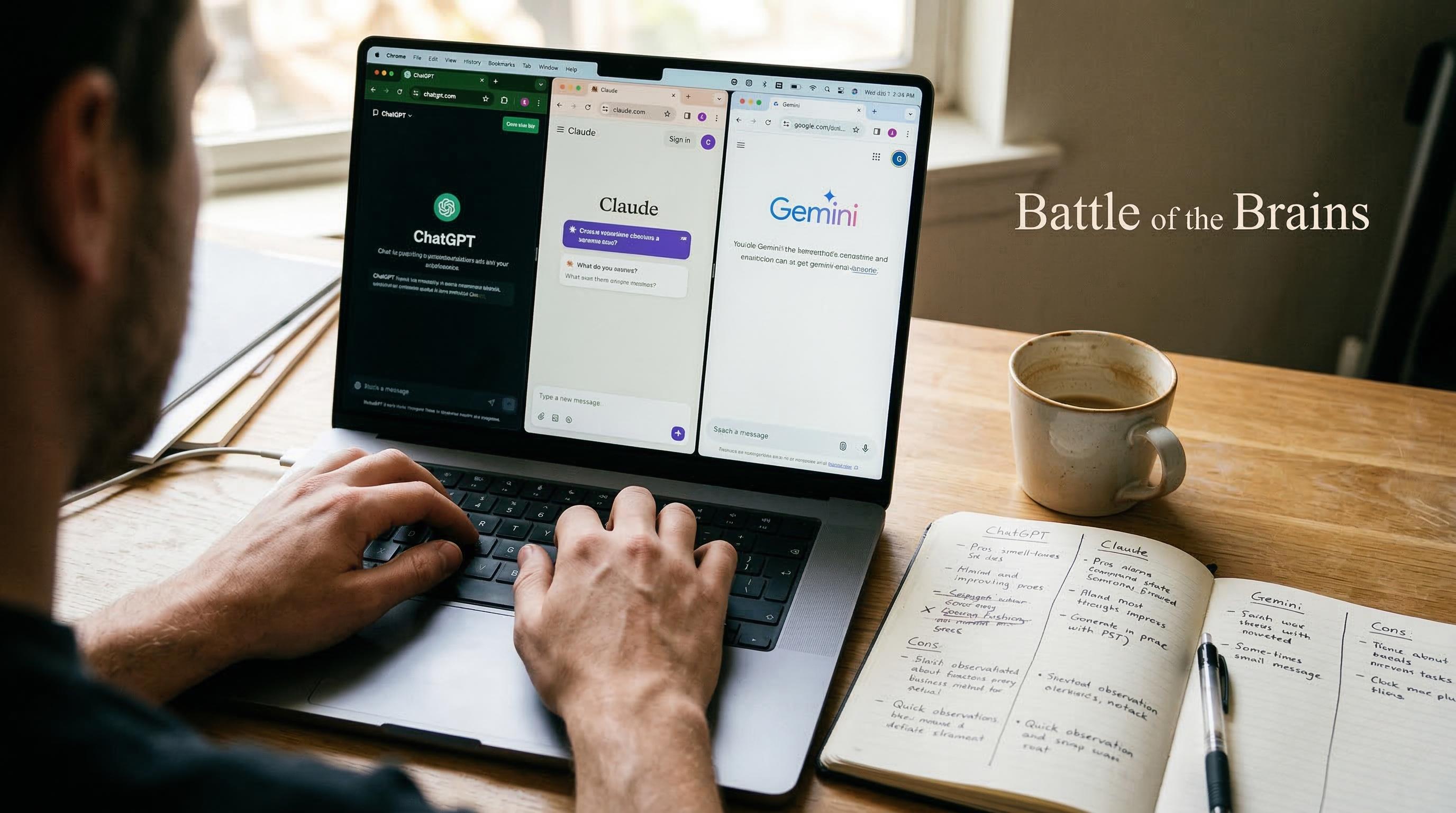
ChatGPT vs Gemini for freelance client work: A practical task test

ChatGPT vs Gemini for freelance client work: A practical task test
Freelancing has changed dramatically with the arrival of generative AI. Independent professionals can now research markets, prepare client proposals, write website content, analyze spreadsheets, create presentations, and respond to customers with the help of AI assistants.
Two tools are particularly interesting for freelancers: ChatGPT by OpenAI and Gemini by Google.
Both promise to save time and improve productivity. But which one actually performs better when you have real client deadlines, demanding customers, and deliverables that need to look professional?
Instead of comparing feature lists, let’s approach this from a freelancer’s perspective.
Imagine you have received a new client project. You need to understand the requirements, prepare a proposal, conduct research, create content, analyze information, and communicate professionally.
Which AI assistant would make your work easier?
This practical task-based comparison explores where ChatGPT and Gemini can help, where they differ, and how freelancers can combine them to deliver better results.
1. ChatGPT vs Gemini: Understanding the difference
Before comparing individual tasks, it is important to understand their strengths.
ChatGPT is an AI assistant from OpenAI designed for conversation, reasoning, writing, research, file analysis, data analysis, and creative work. Its capabilities include web search, file uploads, image generation, custom assistants, and structured data analysis, depending on the account and available tools.
Gemini is Google’s AI assistant, designed to work across Google’s AI ecosystem. It supports writing, research, multimodal interactions, file analysis, and document creation. Its integration with Google services can be particularly useful for people already working with Google Workspace.
Both products evolve frequently, so the exact experience depends on the model, subscription, region, and enabled features.
The important question is not which company has the most impressive AI model. It is which assistant helps you complete your actual freelance assignments more effectively.
2. The practical freelance task test
For this comparison, we will use six common freelance assignments:
- Preparing a client proposal.
- Writing SEO-friendly website content.
- Conducting market and competitor research.
- Analyzing client data and spreadsheets.
- Preparing professional client communication.
- Creating project plans and deliverables.
The same brief should be submitted to both assistants to make the comparison meaningful.
We will evaluate each task using five criteria:
- Quality: Is the output accurate, useful, and relevant?
- Creativity: Does it offer meaningful ideas?
- Professionalism: Is the result suitable for a paying client?
- Time efficiency: How much editing is required?
- Reliability: Does it distinguish facts from assumptions?
This is a reproducible evaluation framework, not a claim that identical live benchmark runs were conducted on both products.
3. Task one: Preparing a client proposal
Imagine a client approaches you to develop a business website with an integrated CRM, payment gateway, and customer management dashboard.
You need to prepare a professional proposal covering scope, architecture, deliverables, timelines, assumptions, and commercial considerations.
Test prompt for both tools:
“Act as a senior freelance technology consultant. Prepare a professional client proposal for developing a business website with CRM integration, payment gateway, customer dashboard, and administrative portal. Include project objectives, scope, technical approach, deliverables, estimated timeline, assumptions, exclusions, risks, and commercial milestones. Use a professional consulting tone and avoid generic marketing language.”
What to evaluate
ChatGPT can help structure complex proposals, develop technical approaches, organize scope, and refine the language through multiple iterations.
Gemini can also create structured proposals and is particularly convenient when the deliverable needs to move into Google Docs or other Google Workspace formats.
The final result depends heavily on how much project context you provide.
Practical verdict: Both are useful. Choose ChatGPT when you want to iteratively develop the technical and commercial narrative. Consider Gemini when your workflow is closely tied to Google Workspace.
4. Task two: Writing SEO-friendly website content
Content writing is one of the most common freelance services. Clients expect original, engaging, well-structured articles that address their audience’s needs.
Suppose your client operates a digital marketing agency and wants an article about AI automation for small businesses.
Test prompt for both tools:
“Act as an experienced SEO content strategist. Write a 1,500-word article about AI automation for small businesses. Include search intent, an engaging introduction, practical examples, H2 and H3 headings, FAQs, a compelling conclusion, and a natural call to action. Avoid keyword stuffing, repetitive phrases, and generic AI-generated language.”
What to evaluate
Look for:
- A compelling introduction.
- Logical content structure.
- Natural keyword placement.
- Relevant examples.
- Consistent tone.
- Original insights.
- Useful FAQs.
ChatGPT is useful for developing a consistent writing style, refining sections, and transforming a rough brief into structured content.
Gemini is also capable of producing detailed articles and can be useful when research and document creation are part of the same Google-oriented workflow.
Neither assistant guarantees originality, factual accuracy, or search engine rankings. You should verify facts, add expertise, and edit the article before delivering it.
Practical verdict: Both can produce strong first drafts. The better choice is the one that follows your client’s brand voice with less editing.
5. Task three: Market and competitor research
Research is an important part of freelance consulting, marketing, business planning, and strategy assignments.
Suppose your client wants to launch a new e-commerce business and asks you to analyze five competitors.
Test prompt for both tools:
“Act as a market research consultant. Research five competitors in the Indian e-commerce technology market. Compare their services, target customers, pricing models where publicly available, key differentiators, strengths, weaknesses, and market positioning. Include source links, publication dates where available, and distinguish verified information from assumptions.”
What to evaluate
- Relevance of competitors.
- Quality of source material.
- Accuracy of business information.
- Evidence supporting conclusions.
- Clarity of recommendations.
Both assistants can support research workflows, but browsing and research capabilities depend on the selected model and enabled tools.
Never assume that a polished research report is necessarily accurate. Check the original sources, especially for prices, market figures, legal requirements, and competitor claims.
Practical verdict: Both are useful research assistants. Evaluate source quality and verification rather than the length of their answers.
6. Task four: Spreadsheet and data analysis
Many freelancers provide reporting, financial analysis, business intelligence, and operational consulting.
Imagine a client shares an Excel file containing monthly sales, customer acquisition, revenue, expenses, and conversion rates.
You need to identify trends and prepare an executive summary.
Test prompt for both tools:
“Analyze the uploaded sales spreadsheet. Identify monthly revenue trends, top-performing products, customer acquisition patterns, conversion rates, unusual variations, and potential business risks. Provide a management summary, relevant charts, key findings, and actionable recommendations. Explain the calculations and assumptions.”
What to evaluate
- Correct interpretation of columns.
- Accurate calculations.
- Ability to identify anomalies.
- Quality of visualizations.
- Clarity of business recommendations.
ChatGPT supports spreadsheet analysis and can use code-backed calculations and visualizations.
Gemini can also analyze files and create spreadsheet-oriented deliverables. Its document-generation capabilities make it useful for workflows that continue into Google Sheets.
For both products, inspect calculations and assumptions before presenting results to a client.
Practical verdict: Both are strong candidates. Test them with the same real-world spreadsheet and compare numerical accuracy, not just the presentation.
7. Task five: Professional client communication
Freelancers regularly communicate with clients about project updates, delayed payments, scope changes, meetings, feedback, and delivery timelines.
A poorly written email can affect your professional relationship.
Test prompt for both tools:
“Rewrite the following message as a professional client email. Maintain a polite and confident tone, communicate the issue clearly, acknowledge the client’s concerns, propose a practical solution, and include a clear next step. Avoid unnecessary formal language.”
What to evaluate
- Professional tone.
- Clarity.
- Conciseness.
- Empathy.
- Appropriate next steps.
ChatGPT is particularly convenient for iterative editing. You can request multiple versions, adjust the tone, and maintain context across follow-up instructions.
Gemini can also produce polished professional communication and can fit naturally into workflows involving Gmail and Google Workspace.
Practical verdict: Both perform well for everyday client communication. Your own instructions and examples of previous emails will make a significant difference.
8. Task six: Project planning and delivery management
Winning a client is only the beginning. You also need to deliver the project on time.
Consider a freelance website development assignment involving design, frontend development, backend APIs, testing, deployment, and training.
Test prompt for both tools:
“Act as an experienced project manager. Create an end-to-end project delivery plan for a business website development project. Include work breakdown structure, tasks, dependencies, estimated duration, milestones, risks, resource requirements, client responsibilities, testing activities, and final acceptance criteria. Present the output in a structured table.”
What to evaluate
- Completeness of the work breakdown.
- Logical task dependencies.
- Realistic timelines.
- Risk identification.
- Clear acceptance criteria.
- Practical usability.
ChatGPT can help develop structured plans and refine them through multiple conversations.
Gemini can generate project-oriented documents and spreadsheets, with convenient handoffs into Google’s productivity tools.
Remember that AI-generated schedules are estimates. Validate them against actual team capacity, project complexity, and client availability.
Practical verdict: Both are capable planning assistants. The quality of the project brief and your own delivery experience matter more than the tool alone.
9. Overall comparison: Which tool should freelancers choose?
Here is a practical decision matrix.
| Freelance activity | ChatGPT | Gemini |
|---|---|---|
| Client proposals | Strong option | Strong option |
| SEO content writing | Strong option | Strong option |
| Market research | Strong option | Strong option |
| Spreadsheet analysis | Strong option | Strong option |
| Professional emails | Strong option | Strong option |
| Project planning | Strong option | Strong option |
| Google Workspace workflow | Depends on integrations | Natural ecosystem fit |
| Iterative content refinement | Strong option | Strong option |
| Document generation | Strong option | Strong option |
These are workflow-oriented assessments, not measured performance scores. Neither assistant wins every task, and individual model versions can change the outcome.
10. Should freelancers use ChatGPT and Gemini together?
Absolutely. You do not necessarily need to choose only one.
A practical approach is to use both assistants for different stages of a client assignment.
For example:
Step 1: Understand the client requirement
Use ChatGPT to analyze the project brief, identify missing information, and develop clarification questions.
Step 2: Conduct research
Use Gemini or ChatGPT with browsing enabled to research the client’s industry, competitors, and market opportunities.
Step 3: Develop the proposal
Use ChatGPT to structure the technical solution, scope, deliverables, assumptions, and commercial milestones.
Step 4: Create client deliverables
Use whichever assistant produces the better output for your document, spreadsheet, or presentation workflow.
Step 5: Review and validate
Cross-check important facts, calculations, technical recommendations, and commercial assumptions using original sources.
Step 6: Communicate with the client
Use either assistant to prepare professional updates, meeting summaries, and follow-up messages.
This approach makes AI a productivity partner rather than a replacement for your professional judgment.
11. How to get better results from both AI assistants
The biggest mistake freelancers make is giving AI vague instructions.
Instead of saying:
“Write a proposal for my client.”
Provide structured information:
- Client industry.
- Business objectives.
- Project requirements.
- Target audience.
- Technology preferences.
- Budget constraints.
- Delivery timeline.
- Expected output format.
- Tone and writing style.
A useful master instruction is:
“You are my freelance business delivery assistant. Work as an experienced consultant in the relevant domain. Before preparing a deliverable, identify missing information and assumptions. Produce practical, client-ready outputs with clear structure, realistic recommendations, and professional language. Never invent facts, prices, references, or commitments. Highlight anything requiring human verification.”
Save this instruction and adapt it for different projects.
12. Important limitations freelancers should understand
AI assistants can save considerable time, but they introduce risks that professionals must manage.
Factual accuracy: AI can generate incorrect information. Verify claims before delivering research or reports.
Confidentiality: Do not upload sensitive client information unless you have permission and the relevant data-handling arrangements are appropriate.
Originality: AI-generated content needs human review, editing, and meaningful expertise.
Commercial commitments: Never allow AI to invent project prices, delivery dates, legal commitments, or contractual obligations.
Technical quality: Generated code, formulas, and architecture recommendations must be tested.
Subscription limitations: Free and paid plans may offer different models, usage limits, integrations, and tools.
Your professional responsibility remains unchanged, regardless of which assistant you use.
13. Final verdict: ChatGPT or Gemini?
So, which one should freelancers choose?
The answer depends on the type of freelance business you operate.
Choose ChatGPT if:
- You frequently prepare detailed client proposals.
- You need iterative writing and editing.
- You work with complex technical requirements.
- You analyze structured data and documents.
- You want a flexible assistant for different types of assignments.
Choose Gemini if:
- Your workflow is heavily based on Google Workspace.
- You regularly work with Google Docs and Sheets.
- You want AI-assisted document creation and editing.
- You prefer working within Google’s productivity ecosystem.
Choose both if:
- You handle different types of client assignments.
- You want a second opinion on important deliverables.
- You want to compare research and recommendations.
- You are building an AI-assisted freelance delivery process.
The bottom line
ChatGPT and Gemini are not simply tools for generating text. They can become important parts of a freelancer’s business operating system.
The real competitive advantage does not come from using the most expensive AI subscription or generating the longest response.
It comes from understanding client requirements, asking better questions, validating AI-generated information, and delivering work that solves real business problems.
Use AI to work faster, but use your expertise to deliver better.
That is what clients ultimately pay for.
Frequently asked questions
1. Is ChatGPT better than Gemini for freelancers?
Neither is universally better. ChatGPT is a flexible choice for writing, reasoning, analysis, and iterative consulting workflows. Gemini is attractive for freelancers working extensively with Google Workspace. Compare the actual models and features available to your account.
2. Can freelancers use ChatGPT to earn money?
Yes. Freelancers can use ChatGPT to support services such as content writing, business research, proposal development, technical documentation, data analysis, automation consulting, and project planning. Income depends on the quality of the service, client demand, and ability to deliver results.
3. Is Gemini good for content writing?
Yes. Gemini can assist with blog posts, website content, marketing copy, email communication, and other writing assignments. Human editing and factual verification remain essential.
4. Can ChatGPT and Gemini analyze Excel files?
Both offer file-related analysis capabilities, although supported formats, limits, and tools vary. Check calculations and formulas before using the results in client reports.
5. Should freelancers pay for both subscriptions?
Not necessarily. Start with the free or lowest-cost options that meet your requirements. Upgrade when you can identify a genuine productivity or quality improvement that justifies the expense.
6. Will AI replace freelance professionals?
AI will automate parts of many freelance workflows, but clients still need people who understand business problems, communicate effectively, exercise judgment, and take responsibility for delivery. Professionals who combine domain expertise with AI tools can create a meaningful competitive advantage.
Your next step
Try the six tasks in this comparison using the same prompts, the same source files, and the same evaluation criteria. Keep a record of editing time, errors, and final output quality.
The best AI assistant is the one that helps you deliver better client outcomes—not simply the one that produces an impressive first response.