How to Price an AI-Enabled Freelance Service Without Undercharging

Freelancers offering AI-powered services are entering one of the fastest-growing opportunities in the digital economy. From AI automation and chatbot development to workflow optimization, data analytics, AI agents, and content systems, businesses are increasingly willing to pay for solutions that save time, reduce operational costs, and increase revenue.
However, one of the biggest mistakes AI freelancers make is underpricing their services.
Many freelancers price their work based on the hours spent building a solution, the cost of AI tools, or what other freelancers charge. This approach often undervalues the expertise, business impact, complexity, and long-term benefits delivered to the client.
The smarter approach is to price AI-enabled freelance services based on a combination of effort, expertise, risk, and measurable business value.
This guide explains how to build a profitable pricing strategy for AI freelance services, create service packages, calculate your minimum price, and avoid common pricing mistakes.
Why AI Freelancers Often Undercharge
AI tools have made it easier to build solutions faster. A freelancer can now use AI coding assistants, automation platforms, APIs, and low-code tools to deliver in days what previously required weeks.
But faster delivery does not mean lower value.
For example, if you build an automated customer support system that reduces a company’s manual support workload by 100 hours per month, the client is not buying the 10 hours you spent configuring the solution. They are buying the business outcome.
Common reasons freelancers undercharge include:
- Charging only for the number of hours spent.
- Competing against low-cost freelancers instead of positioning as specialists.
- Not understanding the financial value of the solution to the client.
- Forgetting discovery, testing, deployment, support, and maintenance.
- Absorbing AI API, hosting, software, and infrastructure costs.
- Offering unlimited revisions without clear boundaries.
- Failing to account for business development and non-billable time.
- Treating AI tools as a reason to reduce their own professional fees.
AI makes delivery more efficient. It should improve your margins—not automatically reduce your price.
1. Choose the Right Pricing Model
Not every AI freelance service should be priced the same way. Your pricing model should reflect the type of service, project complexity, client expectations, and business value.
Freelance Icon at Vectorified.com | Collection of Freelance Icon free for personal use
Hourly pricing
Best for troubleshooting, consulting, advisory sessions, or work with uncertain requirements.
Example: $75–$150/hour
Travel Marketplace Software Development Services | Onix
Fixed project pricing
Best for clearly defined deliverables such as chatbot implementations, AI workflows, integrations, and dashboards.
Example: $1,500–$10,000 per project
什么是业务报告以及为什么它们很重要:示例和模板 – DataFocus
Monthly retainer pricing
Best for continuous optimization, AI monitoring, workflow maintenance, support, and ongoing consulting.
Example: $500–$5,000+ per month
The Psychology of Pricing: How to Value Your Work Based on ROI, Not Hours | BillerBear Blog
Value-based pricing
Best when your solution directly improves revenue, reduces costs, increases productivity, or eliminates repetitive work.
Example: Pricing based on a defined business outcome
Which model should you choose?
For most AI freelancers, a hybrid approach is the strongest:
- Use hourly pricing for consulting and uncertain work.
- Use fixed pricing for defined implementations.
- Use value-based pricing when business impact is measurable.
- Use retainers for ongoing support and optimization.
This approach protects your income while making your services easier for clients to purchase.
2. Calculate Your Minimum Profitable Rate
Before quoting clients, determine the minimum rate required to operate a sustainable freelance business.
Your hourly rate should not simply be your desired salary divided by the number of hours in a month.
Freelancers have expenses and non-billable work, including:
- Client acquisition
- Sales calls
- Proposal preparation
- Project management
- Research
- Learning and experimentation
- Administrative work
- Software subscriptions
- Taxes
- Downtime between projects
Freelancer pricing formula
Minimum hourly rate
\[ \frac{\text{Monthly income target + monthly expenses}} {\text{Monthly billable hours}} \]
Example calculation
Assume your freelance business has the following targets:
| Item | Monthly Amount |
|---|---|
| Desired personal income | $6,000 |
| Business expenses | $1,000 |
| Tax and contingency reserve | $1,500 |
| Total monthly revenue target | $8,500 |
| Billable hours per month | 80 |
Your minimum hourly revenue requirement would be:
\[ \$8,500 \div 80 = \$106.25 \]
That means your effective rate should be approximately $106 per billable hour just to meet the target.
You might therefore establish a commercial rate of $125–$150 per hour, depending on your expertise, niche, and market.
Remember that this is your internal pricing calculation. Clients do not necessarily need to see your hourly calculation when you sell a fixed-price package.
3. Price AI Services Based on Business Value
Value-based pricing is one of the most powerful strategies for AI freelancers.
Instead of asking:
How many hours will it take me to build this?
Ask:
How much financial or operational value will this solution create for the client?
Example: AI customer support automation
A business currently has employees handling repetitive support inquiries.
| Business Metric | Value |
|---|---|
| Manual support workload | 120 hours/month |
| Estimated cost per employee hour | $20 |
| Potential monthly labor value | $2,400 |
| Estimated automation efficiency | 50% |
| Potential monthly savings | $1,200 |
If your AI automation solution saves approximately $1,200 per month, it may deliver $14,400 in annual savings.
A project fee of $3,000–$5,000 could be commercially reasonable if the system reliably delivers the expected value, the scope is defined, and the client understands the implementation and operating costs.
The client may recover their investment in a few months, while you are compensated for the technical expertise and business outcome.
Value-based pricing formula
Value-based project pricing
\[ \text{Project Price} = \text{Expected Client Value} \times \text{Value Capture Percentage} \]
For example, if your solution generates an estimated $12,000 in annual savings and you capture 25% of that value:
\[ \$12,000 \times 25\% = \$3,000 \]
This gives you a value-based reference price of $3,000.
The percentage is not a universal benchmark. It should depend on the reliability of the benefit, the implementation scope, alternatives available to the client, and the perceived value of your solution.
4. Create Three Service Packages
Clients often struggle to make purchasing decisions when presented with a single offer.
Instead, create three packages to help clients choose based on their budget and requirements.
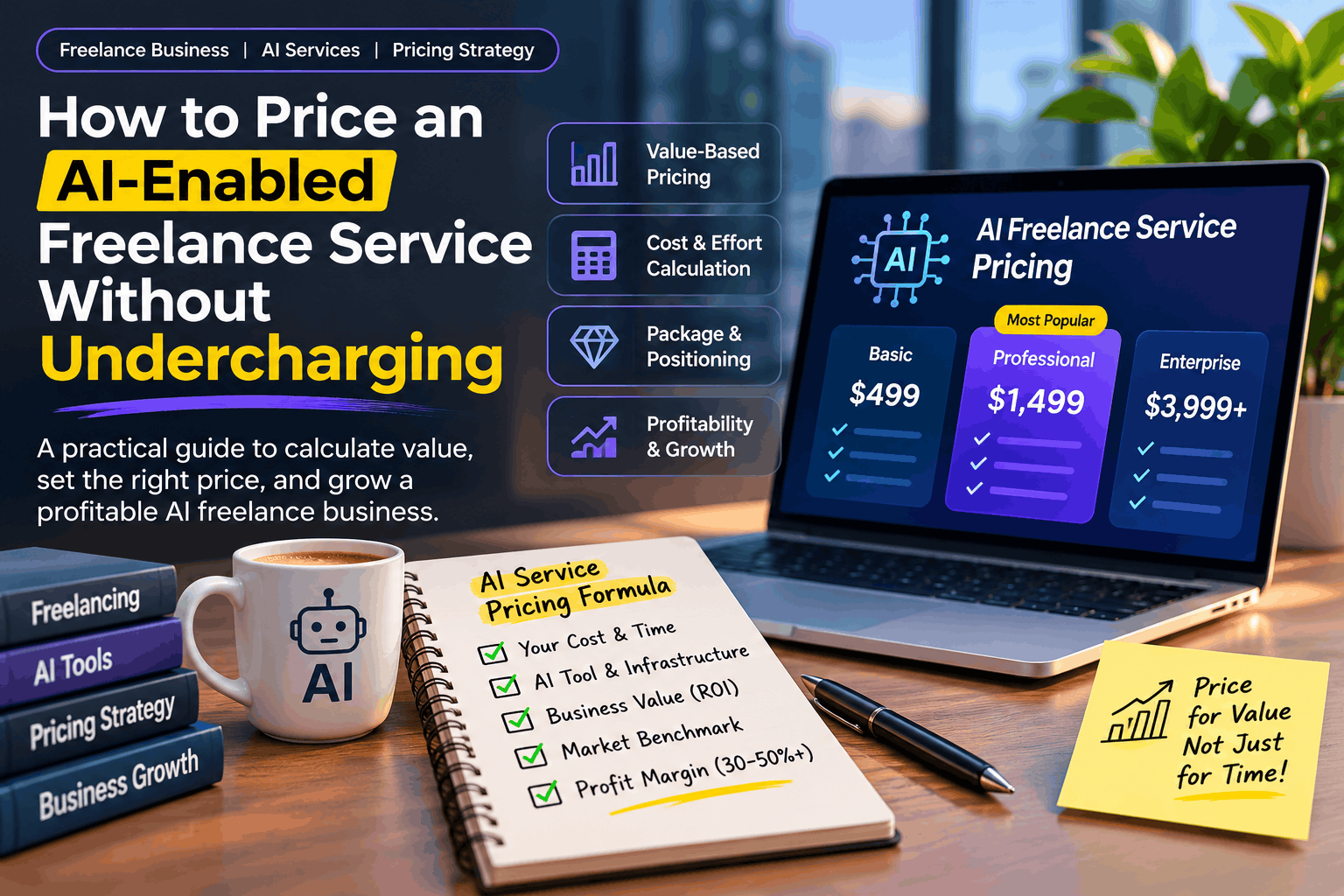
Basic — AI Starter
Entry Package
$499–$999
For small businesses exploring AI
- One workflow automation
- Basic AI integration
- One business process
- Initial configuration
- Basic documentation
Professional — AI Growth
Recommended
$1,500–$4,000
For businesses looking to automate multiple workflows
- AI-powered workflow automation
- API and third-party integrations
- Knowledge base or RAG implementation
- Testing and optimization
- Documentation and training
- 30-day post-launch support
Enterprise — AI Transformation
$5,000–$15,000+
For complex or business-critical requirements
- Multi-workflow AI solution
- Advanced integrations
- AI agents and orchestration
- Security and governance
- Performance and scalability design
- Deployment and monitoring
- Extended support options
These are illustrative positioning ranges, not fixed market prices. Adjust them for geography, complexity, scope, expertise, client budget, and expected ROI.
The middle package should generally be your primary offer. It gives clients a meaningful solution without the complexity or cost of a larger enterprise implementation.
5. Account for AI Tools and Infrastructure Costs
AI freelance projects can have ongoing costs even after deployment.
Depending on the solution, you may need to account for:
- LLM API consumption
- Vector database hosting
- Cloud compute
- Serverless functions
- Workflow automation platforms
- Monitoring tools
- Storage
- Third-party APIs
- Security services
- Data processing
The Hidden Cost of AI Agents: Why ‘Free’ Isn’t Free | by Balaram Panda | Medium
Scalable Infrastructure | Epsilla’s AI Platform with High Availability and Enterprise Security
AWS Cost Estimate Tracker: Enhanced Insights with Generative AI – DEV Community
7
Separate implementation fees from operating costs
A professional proposal should clearly distinguish between:
| Cost Category | Pricing Treatment |
|---|---|
| AI solution design | One-time fee |
| Development and implementation | One-time fee |
| Integration and testing | One-time fee |
| Cloud infrastructure | Monthly client cost |
| AI API consumption | Usage-based client cost |
| Monitoring and maintenance | Monthly retainer |
| New features | Separately quoted |
Avoid paying recurring infrastructure bills from your fixed project fee unless those expenses have been explicitly included in your contract.
6. Build Recurring Revenue Through AI Retainers
One of the biggest challenges for freelancers is unpredictable income.
You can reduce this risk by offering recurring services after implementation.
Example AI monthly support packages
| Package | Monthly Price | Services |
|---|---|---|
| Essential | $300–$750 | Monitoring, basic support, minor fixes |
| Growth | $1,000–$2,000 | Optimization, analytics, workflow improvements |
| Advanced | $2,500–$5,000+ | AI performance reviews, advanced optimization, new workflow improvements, strategic advisory |
Recurring services may include:
- AI model performance monitoring
- Prompt and workflow optimization
- Knowledge base updates
- Cost optimization
- Error monitoring
- Integration maintenance
- Monthly analytics reporting
- Business process improvement
- New automation opportunities
A successful implementation should be the beginning of a client relationship—not necessarily the end of the project.
7. Add a Profit Margin to Every Project
Many freelancers calculate project costs correctly but forget to add a profit margin.
Your price should cover:
- Direct project costs.
- Your delivery effort.
- Business overhead.
- Risk and contingency.
- Profit.
Example project cost breakdown
| Component | Estimated Cost |
|---|---|
| Discovery and requirements | $300 |
| Architecture and design | $500 |
| Development and implementation | $1,200 |
| Testing and deployment | $400 |
| AI tools and infrastructure during development | $100 |
| Project overhead | $200 |
| Total estimated cost | $2,700 |
If you want a 30% gross margin, the correct pricing formula is:
\[ \text{Price}=\frac{\text{Cost}}{1-\text{Margin}} \]
Therefore:
\[ \$2,700 \div 0.70 = \$3,857 \]
Your project price should be approximately $3,850, rather than simply adding 30% to the cost.
This distinction is important because a 30% markup is not the same as a 30% profit margin.
8. Define Scope to Avoid Unpaid Work
Undercharging is not always caused by a low initial quote. It is often caused by scope creep.
A project initially estimated at $2,000 can quickly become a $5,000 project if the client continuously requests new features, additional integrations, or changes to the original workflow.
Every proposal should clearly define:
- Project objectives
- Deliverables
- Number of workflows
- Number of integrations
- Data sources
- Supported AI models
- User access requirements
- Testing requirements
- Deployment environment
- Revision limits
- Client responsibilities
- Exclusions
- Timeline
- Payment milestones
- Support period
Example scope protection clause
Project Scope and Change Requests
The project fee covers the deliverables, integrations, workflows, and implementation activities specifically defined in the approved scope of work.
Any additional features, integrations, workflow changes, new data sources, substantial design changes, or requirements introduced after project approval will be evaluated separately and may require an additional fee and timeline adjustment.
Minor corrections related to the agreed deliverables will be handled during the defined revision and warranty period.
Clear scope is one of the easiest ways to protect your profit.
9. Use a Pricing Strategy That Positions You as a Specialist
AI freelancing is becoming competitive. Selling yourself as someone who can “build anything using AI” may attract low-budget clients.
Instead, position your service around a business problem.
For example:
| Generic Positioning | Specialist Positioning |
|---|---|
| AI chatbot developer | AI customer support automation specialist |
| AI automation freelancer | AI workflow automation for operations teams |
| Prompt engineer | AI knowledge systems and RAG consultant |
| AI developer | AI-powered business process transformation consultant |
| Data analyst | AI-driven decision intelligence specialist |
| AI agent developer | Autonomous workflow and agent orchestration specialist |
Specialists are easier to trust because clients understand the problem you solve.
A niche also helps you reuse components, templates, architecture patterns, and delivery processes—improving profitability without sacrificing quality.
10. A Practical AI Freelance Pricing Worksheet
Before sending a proposal, use this checklist.
Project pricing checklist
- Identify the business problem.
- Estimate measurable value to the client.
- Calculate delivery hours.
- Include discovery and project management.
- Estimate AI tools and infrastructure costs.
- Include testing and deployment.
- Add contingency for project risks.
- Set a target margin.
- Define deliverables and exclusions.
- Offer a fixed scope and timeline.
- Identify potential monthly recurring services.
- Validate the price against the client’s value and market alternatives.
Quick pricing calculator
Estimate your project price
Step 1 — Calculate your delivery cost
\[ \text{Hours} \times \text{Internal Hourly Rate} \]
Step 2 — Add direct costs
\[ \text{Delivery Cost}+\text{Tools}+\text{Infrastructure} \]
Step 3 — Add contingency
\[ \text{Estimated Cost}\times(1+\text{Risk \%}) \]
Step 4 — Set your target margin
\[ \text{Final Price}=\frac{\text{Total Cost}}{1-\text{Target Margin}} \]
11. Example: Pricing an AI Automation Project
Imagine a client wants to automate lead qualification and customer follow-up using an AI workflow.
The solution includes:
- Lead ingestion from web forms
- AI-based lead qualification
- CRM integration
- Automated follow-up emails
- Lead scoring
- Reporting dashboard
- Error monitoring
Your estimate might look like this:
| Work Item | Hours |
|---|---|
| Discovery | 5 |
| Architecture | 6 |
| Workflow development | 18 |
| AI configuration | 10 |
| CRM integration | 8 |
| Testing | 6 |
| Deployment | 4 |
| Documentation and training | 3 |
| Total | 60 hours |
At an internal delivery rate of $100/hour:
\[ 60 \times \$100 = \$6,000 \]
Add $500 in direct costs and $500 contingency:
\[ \$6,000+\$500+\$500=\$7,000 \]
If your target margin is 30%:
\[ \$7,000 \div 0.70 = \$10,000 \]
A project proposal around $10,000 could therefore be appropriate as a cost-and-margin-based starting point, subject to scope, client budget, market positioning, and business value.
The client may be purchasing an outcome that saves hundreds of hours annually or significantly improves lead conversion. Your price should reflect the business impact—not just the coding effort.
12. How to Respond When a Client Says Your Price Is Too High
Avoid immediately reducing your price.
Instead, use one of these approaches.
Option A: Reduce scope
I can certainly work within a lower budget. To align with that investment, I recommend reducing the implementation scope to the core workflow and postponing the additional integrations and advanced analytics to a later phase.
Option B: Offer phased implementation
We can approach this in phases. Phase 1 will focus on the core automation and measurable business outcome. Once the solution is validated, we can expand into additional workflows and advanced AI capabilities.
Option C: Explain the value
The proposal is based on the complete solution, including architecture, implementation, integrations, testing, deployment, and post-launch stabilization. The objective is not just to introduce AI but to implement a reliable solution that creates measurable business value.
Option D: Offer payment milestones
Instead of reducing the fee, offer a payment structure:
- 40% upon project kickoff
- 40% upon completion of core implementation
- 20% upon final deployment and handover
This can make a premium project more financially accessible.
13. The Most Profitable AI Freelance Services to Package
Instead of selling generic AI development, build repeatable service offerings.
Converiqo AI – Redefining Workflow Automation Efficiency
AI Business Automation Platform In India | Dhiyo Ai Labs
9
| Service | Example Starting Range |
|---|---|
| AI chatbot implementation | $1,000–$5,000 |
| AI knowledge base / RAG system | $2,000–$10,000 |
| Business workflow automation | $1,500–$7,500 |
| AI lead qualification system | $2,000–$8,000 |
| AI document processing | $2,500–$12,000 |
| AI analytics and reporting | $2,000–$10,000 |
| AI agent implementation | $3,000–$15,000+ |
| AI readiness assessment | $500–$3,000 |
| AI strategy and architecture consulting | $1,000–$5,000+ |
| AI automation maintenance | $500–$3,000/month |
These are indicative package ranges. Actual pricing depends on client type, requirements, data quality, integrations, security, deployment, and complexity.
The strongest strategy is to develop a few repeatable solutions for a specific industry rather than continuously building completely custom solutions from scratch.
14. Build Your AI Freelance Revenue Model
Your goal should not be to maximize the number of projects. It should be to maximize profitable delivery while creating predictable income.
For example, a freelance business could target the following monthly revenue mix:
| Revenue Stream | Quantity | Average Price | Monthly Revenue |
|---|---|---|---|
| AI implementation projects | 2 | $3,000 | $6,000 |
| Monthly retainers | 4 | $1,000 | $4,000 |
| AI consulting engagements | 4 | $500 | $2,000 |
| Total | $12,000/month |
This model combines project revenue, recurring revenue, and advisory income.
It is usually more sustainable than relying entirely on one-off development projects.
Conclusion: Stop Selling Hours, Start Selling Outcomes
AI is changing how freelance services are delivered, but it should not destroy the value of professional expertise.
The freelancers who build sustainable businesses will be those who understand the client’s problem, design reliable solutions, measure business impact, and position themselves as trusted specialists.
When pricing an AI-enabled freelance service, remember:
- Calculate your minimum profitable rate.
- Include non-billable time and overhead.
- Price based on outcomes whenever possible.
- Create clear service packages.
- Separate implementation fees from ongoing operating costs.
- Protect your scope.
- Build recurring revenue.
- Communicate value instead of defending hours.
You are not selling prompts, API calls, or hours of coding. You are selling business improvement, automation, expertise, and outcomes.
Price accordingly.
SEO Publishing Pack
SEO title
How to Price an AI-Enabled Freelance Service Without Undercharging
Meta description
Learn how to price AI freelance services profitably using value-based pricing, project packages, cost calculations, retainers, and practical examples.
URL slug
how-to-price-ai-enabled-freelance-service
Focus keyword
AI freelance service pricing
Secondary keywords
- AI freelancer pricing strategy
- How to charge for AI automation
- AI consulting pricing
- Value-based pricing for freelancers
- AI freelance business
- AI automation service pricing
- AI consulting rates
- Freelance AI project pricing
Article excerpt
Discover how to price AI-enabled freelance services without undercharging. Learn to calculate profitable rates, create service packages, charge based on business value, protect your project scope, and build recurring income through AI consulting and automation services.
SEO-Friendly FAQs
1. How much should I charge for AI freelance services?
AI freelancers may charge from a few hundred dollars for simple automation tasks to several thousand dollars for advanced AI integrations, agentic systems, enterprise automation, and consulting. Pricing depends on expertise, complexity, business impact, and deliverables.
2. Should AI freelancers charge hourly or fixed prices?
Hourly pricing is useful for consulting and undefined work. Fixed pricing is generally better for clearly scoped AI implementations because it gives clients cost certainty and rewards freelancers for efficiency.
3. How do I calculate the price of an AI automation project?
Estimate discovery, architecture, development, integration, testing, deployment, support, infrastructure, and overhead. Add contingency and calculate your final price using your target profit margin.
4. Is value-based pricing better for AI services?
Value-based pricing can be highly effective when the AI solution generates measurable business benefits, such as cost savings, increased conversions, faster processing, or reduced manual effort.
5. How can AI freelancers earn recurring revenue?
Offer monthly maintenance, AI monitoring, prompt and workflow optimization, knowledge base updates, API monitoring, cloud cost optimization, analytics, and ongoing consulting retainers.
6. How do I avoid undercharging AI clients?
Calculate your minimum profitable rate, define your scope clearly, estimate operating costs, avoid unlimited revisions, package your services, and understand the financial impact of the solution.