Turn One Client Project into Five Ethical Marketing Assets: A Practical Guide for Freelancers

Turn One Client Project into Five Ethical Marketing Assets: A Practical Guide for Freelancers
One successful client project can do much more than generate revenue. It can become a powerful marketing engine that helps you attract new clients, demonstrate expertise, build credibility, and grow your freelance business.
Freelancers and independent consultants often make one common mistake: they finish a project, deliver the final work, receive payment, and immediately move on to the next assignment.
But what if the project you have just completed could generate five additional marketing assets?
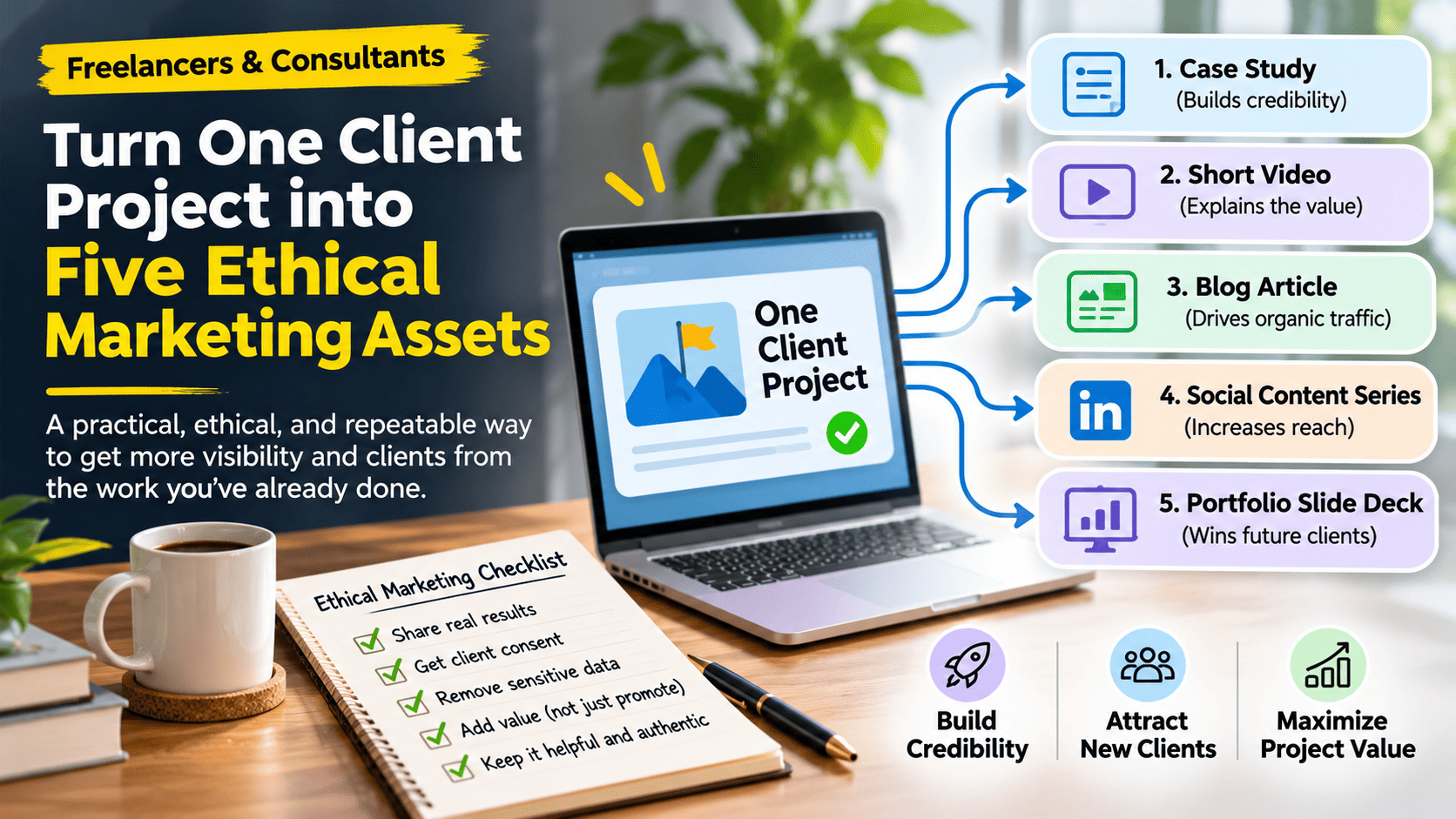
Imagine transforming a single website development project into a detailed case study, a blog article, a short educational video, a LinkedIn content series, and a portfolio presentation.
Instead of constantly creating new marketing material from scratch, you can build a repeatable content strategy around work you have already completed.
However, there is one important condition: your marketing must remain ethical, transparent, and respectful of client confidentiality.
In this guide, we will explore how to turn one client project into five valuable marketing assets, with practical examples, AI-assisted workflows, and a reusable checklist.
Why Should Freelancers Repurpose Client Projects?
Marketing is one of the biggest challenges for independent professionals. Finding new clients requires consistent visibility, but producing original content every week takes considerable time.
Your completed projects already contain valuable marketing material:
- Problems you successfully solved.
- Technical approaches and methodologies you applied.
- Business improvements you helped deliver.
- Lessons learned during execution.
- Challenges that other potential clients may also experience.
By repurposing this information, you can demonstrate your capabilities through real-world experience rather than relying entirely on promotional claims.
For example, a freelance AI consultant who builds an automated customer support solution can create several educational resources from that single engagement.
These resources can help prospective customers understand the problem, evaluate the consultant’s expertise, and become interested in similar services.
Before You Start: Follow Five Ethical Marketing Principles
Before converting client work into marketing content, establish clear boundaries.
1. Obtain client permission
Never assume that completing a project gives you permission to publish its details.
Ask the client for written approval before using their company name, logo, screenshots, testimonials, project results, or identifiable information.
2. Protect confidential information
Remove sensitive business information, personal data, internal documents, customer records, credentials, financial details, and proprietary implementation information.
Anonymization should be meaningful. Simply removing a company name may not be sufficient if other details identify the client.
3. Respect intellectual property
Check your contract and applicable intellectual property agreements before publishing code, designs, documents, diagrams, or other project deliverables.
Use only materials you have the right to share.
4. Present results honestly
Do not exaggerate project outcomes or invent performance improvements.
If a project reduced processing time by 20%, report that figure only when it is supported by reliable evidence and approved for publication.
If you cannot disclose actual results, explain the methodology without making unsupported numerical claims.
5. Add educational value
Your marketing content should help readers understand something useful.
Avoid publishing five versions of the same advertisement. Each asset should provide a different perspective, insight, or learning opportunity.
The Five Marketing Assets You Can Create from One Client Project
Let’s explore a practical example.
Suppose you are an independent technology consultant who recently completed an AI-powered workflow automation project for a business.
The client wanted to reduce manual administrative work, improve process consistency, and automate repetitive activities.
You can transform this engagement into five marketing assets.
Asset 1: Create a Detailed Project Case Study
Purpose: Establish credibility and demonstrate your problem-solving capabilities.
A case study is one of the most effective ways to demonstrate your professional expertise.
Instead of simply saying that you build AI automation solutions, show prospective clients how you approach business problems and deliver solutions.
A good case study should contain the following sections:
1. Project background
Describe the business context without revealing confidential information.
2. Business challenge
Explain the problem the client wanted to solve.
3. Your approach
Describe your discovery process, technology selection, architecture, implementation methodology, and decision-making process.
4. Solution delivered
Explain the major components of the solution and how they addressed the original requirements.
5. Outcomes
Share verified results where permission exists. Otherwise, describe qualitative improvements without making unsupported claims.
6. Key lessons
Explain what you learned and what other businesses can take away from the experience.
Example headline:
“How AI Workflow Automation Can Reduce Repetitive Administrative Work for Growing Businesses”
Marketing channels: Your website, portfolio, LinkedIn profile, and proposals.
Ethical tip: If you do not have permission to identify the client, use a genuinely anonymized description such as “A mid-sized professional services company.” Do not imply an endorsement or relationship that the client has not approved.
Asset 2: Turn the Project into an Educational Blog Article
Purpose: Generate organic traffic and establish subject-matter expertise.
A project case study can become the foundation for a broader educational article.
The key is to move beyond describing what you delivered and explain how readers can solve a similar problem.
For example, your AI automation project could generate an article titled:
“How Small Businesses Can Automate Repetitive Tasks Using AI and No-Code Tools”
The article could cover:
- Common business process automation opportunities.
- Identifying repetitive administrative tasks.
- Selecting suitable AI and automation tools.
- Designing an automation workflow.
- Integrating business applications.
- Testing and monitoring automated processes.
- Avoiding common implementation mistakes.
Include practical diagrams, sample workflows, implementation tips, and relevant resources.
You can also incorporate internal links to your existing service pages and related educational articles.
Recommended SEO approach:
Target specific search phrases such as:
- AI workflow automation for small businesses.
- Business process automation.
- AI automation tools for freelancers.
- No-code business automation.
Marketing channels: WordPress, Google search, newsletters, and professional communities.
Ethical tip: Make the article educational rather than disguising a client project as an independently verified industry study.
Asset 3: Produce a Short Educational Video
Purpose: Build engagement and explain your expertise visually.
A completed project can also provide the foundation for a short educational video.
You do not need an expensive production setup. A screen recording, simple presentation, voice-over, and basic editing can be enough.
For example:
Video title: “5 Business Tasks You Can Automate Using AI”
Suggested video structure:
- First 5 seconds: Introduce the business problem.
- Next 15 seconds: Explain why manual processes create inefficiencies.
- Next 30 seconds: Demonstrate a generic automation workflow.
- Next 20 seconds: Explain implementation considerations.
- Final 10 seconds: Share a practical takeaway and invite viewers to explore your services.
You can create several video formats:
- A 60-second LinkedIn video.
- A short YouTube video.
- An educational tutorial.
- A longer implementation walkthrough.
Use generic or recreated demonstrations unless you have explicit permission to show actual client systems and materials.
Marketing channels: LinkedIn, YouTube, Instagram, and your website.
Ethical tip: Never expose client dashboards, account information, customer records, or proprietary interfaces in screen recordings.
Asset 4: Build a LinkedIn Social Media Content Series
Purpose: Increase visibility and build professional relationships.
One client project can easily provide enough insights for a five-post LinkedIn series.
Rather than publishing a single promotional post, distribute the lessons across multiple posts.
Here is an example:
Post 1: The problem
“Many growing businesses still spend hours on repetitive administrative activities. Here are three signs that your workflow needs automation.”
Post 2: The approach
“Before implementing AI automation, start by mapping the existing business process. Automation without process understanding can create more problems than it solves.”
Post 3: The technology
“How AI, APIs, and workflow automation platforms can work together to eliminate repetitive manual activities.”
Post 4: Lessons learned
“Five important lessons from designing reliable business automation workflows.”
Post 5: Practical recommendations
“How to identify your first business automation opportunity without investing in an expensive technology platform.”
Each post should provide an independent takeaway.
You can use relevant diagrams, simple illustrations, and short videos to improve engagement.
Marketing channels: LinkedIn, professional groups, and relevant online communities.
Ethical tip: Avoid tagging clients, publishing their logos, or implying that they endorse your services unless they have explicitly authorized it.
Asset 5: Create a Portfolio Presentation or Service Deck
Purpose: Convert marketing interest into business opportunities.
Your final asset should help prospective customers understand what you can deliver.
Create a short portfolio presentation using lessons from your completed project.
A practical presentation structure includes:
- Introduction and professional expertise.
- Business problem addressed.
- Your solution approach.
- Architecture or implementation methodology.
- Relevant technologies and capabilities.
- Verified outcomes or qualitative benefits.
- Lessons applicable to similar businesses.
- Services offered and next steps.
You can use PowerPoint, Canva, or Google Slides to build a professional presentation.
For technology consultants, include architecture diagrams, process flows, integration patterns, and implementation roadmaps where disclosure is permitted.
For freelancers in other industries, replace technical diagrams with suitable examples of creative work, deliverables, or business processes.
Marketing channels: Sales meetings, email introductions, proposals, networking events, and your website.
Ethical tip: Clearly distinguish between work you personally delivered, work completed by a team, and capabilities you are proposing for future projects.
How AI Can Help You Create These Five Assets Faster
AI tools can significantly reduce the time required to transform project knowledge into marketing content.
However, AI should assist with drafting and repurposing, not invent project facts or determine what you are authorized to disclose.
A practical workflow looks like this:
| Activity | AI-assisted task |
|---|---|
| Case study | Organize project notes into a structured narrative |
| Blog article | Develop educational content from approved project insights |
| Video | Generate scripts and storyboards |
| Social posts | Extract distinct lessons and create post variations |
| Portfolio | Organize approved information into presentation sections |
You can use tools such as ChatGPT for writing, Canva for visual assets, and video editing tools for short educational content.
Example AI prompt
“Act as an experienced content marketing strategist for independent consultants.
Using the approved and anonymized project information below, create five distinct marketing assets:
- A professional project case study.
- An educational SEO-focused blog article.
- A 60-second educational video script.
- Five LinkedIn posts with different educational angles.
- A professional portfolio presentation outline.
Requirements:
- Do not invent statistics, business outcomes, testimonials, or project details.
- Do not reveal confidential information.
- Preserve technical accuracy.
- Highlight practical lessons and transferable expertise.
- Use a professional, authentic, and educational tone.
- Identify any information that requires client approval before publication.
Approved project information:
[Insert approved project notes here]”
This prompt can serve as the foundation for a repeatable content production process.
A Practical Seven-Day Content Repurposing Workflow
You do not need an entire marketing team to implement this strategy.
A solo freelancer can follow this simple seven-day schedule.
| Day | Activity | Deliverable |
|---|---|---|
| Day 1 | Review project and permissions | Approved project brief |
| Day 2 | Prepare the case study | Case study draft |
| Day 3 | Develop educational content | WordPress article |
| Day 4 | Write and record video | Short educational video |
| Day 5 | Create social content | Five LinkedIn posts |
| Day 6 | Prepare presentation | Portfolio deck |
| Day 7 | Review and distribute | Published marketing assets |
The schedule is a suggested production plan, not a requirement to publish everything within seven days. Obtain approvals before publication and adjust the timeline accordingly.
Common Mistakes to Avoid
Even a strong project can become a weak marketing asset if handled incorrectly.
Avoid these common mistakes:
1. Publishing without permission
Never assume that a successful client relationship automatically grants marketing rights.
2. Creating repetitive content
Five assets should have five different purposes. Simply copying and pasting the same message across five platforms will not create meaningful engagement.
3. Exaggerating results
Avoid unsupported revenue figures, productivity claims, and performance improvements.
4. Overusing AI-generated content
Review every AI-generated asset for accuracy, originality, tone, and confidentiality.
5. Ignoring the audience
Explain how your experience helps potential customers solve their problems instead of focusing entirely on your own achievements.
6. Forgetting the call to action
Give readers a natural next step, such as exploring your services, reading a related guide, or scheduling a discovery conversation.
How to Measure the Marketing Value of Repurposed Content
Creating content is only one part of the process. You should also understand whether the assets are helping your business.
Track a few meaningful metrics:
- Website visits generated by your case study.
- Organic search impressions and clicks.
- LinkedIn post engagement and profile visits.
- Video views and audience retention.
- Portfolio presentation downloads or shares.
- Qualified inquiries generated through your content.
- Discovery calls and business opportunities.
Focus on qualified leads and meaningful business conversations rather than chasing vanity metrics.
For example, ten relevant inquiries from business owners may be more valuable than thousands of unrelated social media impressions.
Conclusion: Make Every Completed Project Work Harder
Your completed client projects represent more than delivered assignments. They contain valuable experience, insights, practical lessons, and evidence of your professional capabilities.
By converting one project into a case study, educational article, short video, social media series, and portfolio presentation, you can build a consistent marketing system without constantly starting from scratch.
The secret is to approach content repurposing strategically.
Respect client permissions, protect confidential information, present results honestly, and make every piece of content useful to its intended audience.
One project can create five marketing opportunities. Five useful assets can strengthen your professional visibility. And consistent, ethical visibility can help create new business opportunities.
Start with your next completed project. Document the lessons, obtain the necessary approvals, and turn your experience into something that helps others.
Frequently Asked Questions (FAQs)
1. Can freelancers use client projects for marketing?
Yes, provided they have the necessary permissions and rights. Review contractual obligations, intellectual property provisions, confidentiality requirements, and applicable data protection obligations before publishing.
2. What are the best marketing assets to create from one client project?
A project case study, educational blog article, short video, LinkedIn content series, and portfolio presentation are five useful formats.
3. Can AI automatically convert a client project into marketing content?
AI can assist with drafting, summarizing, repurposing, and formatting. However, a human should verify accuracy, remove confidential information, and confirm publication permissions.
4. How many LinkedIn posts can one client project generate?
A single project can provide several distinct educational insights. Five posts are a practical starting point, provided each offers a different takeaway.
5. What if the client does not allow public disclosure of the project?
You can still share general professional knowledge, reusable methodologies, and independently created educational examples, provided they do not disclose confidential information or reproduce protected client materials.
6. How often should freelancers repurpose their completed projects?
Make project documentation and content planning part of your regular delivery process. Repurpose suitable projects when you have enough original insight and the necessary permissions.
Final takeaway: Don’t let valuable project experience disappear after delivery. Turn your expertise into educational content, build trust with your audience, and create a sustainable marketing process around the work you already do.