Prompt Library for Discovery Calls: Questions That Uncover Scope

A discovery call is one of the most important conversations between a freelancer and a potential client. It is where you move beyond a vague project idea, understand the client’s actual business problem, identify expectations, and determine what needs to be delivered.
Many freelancers make the mistake of jumping directly into pricing, timelines, and solutions. However, without understanding the complete project scope, even a seemingly straightforward assignment can turn into endless revisions, unexpected requirements, missed deadlines, and reduced profitability.
The solution? Use a structured discovery-call process supported by AI prompts.
In this article, we’ll explore a practical prompt library that freelancers, consultants, developers, designers, and digital service providers can use to conduct better discovery calls, uncover hidden requirements, and prepare accurate project proposals.
1. Why discovery calls matter
A discovery call is not simply a sales conversation. It is a structured requirement-gathering exercise.
Its primary objective is to understand five things:
- Business objectives: What problem is the client trying to solve?
- Project requirements: What exactly needs to be built or delivered?
- Scope boundaries: What is included and excluded?
- Constraints: What are the budget, timeline, resources, and technical limitations?
- Success criteria: How will the client measure project success?
Without these details, freelancers often underestimate the work involved.
For example, a client might request a simple business website. During the discovery call, you might discover that the actual requirement includes:
- A custom-designed website.
- Customer registration and authentication.
- Payment gateway integration.
- CRM integration.
- Automated email notifications.
- An administration dashboard.
- SEO configuration.
- Analytics and reporting.
What initially appeared to be a small website project could actually be a complete digital solution.
The key principle: Never estimate a project based only on the client’s initial description. Discover the requirements before committing to scope, price, or delivery dates.
2. Prepare for the discovery call using AI
Before speaking with the client, use AI to prepare a structured set of questions based on the information already available.
Prompt 1: Generate a discovery-call preparation checklist
Act as an experienced business analyst and freelance consulting specialist.
I have received the following project inquiry from a potential client:
[Paste client inquiry or project description]
Analyze the inquiry and prepare a discovery-call checklist covering:
- Client business objectives.
- Business problems and pain points.
- Functional requirements.
- Non-functional requirements.
- Technical dependencies.
- Third-party integrations.
- Expected deliverables.
- Budget and commercial expectations.
- Project timeline and milestones.
- Potential risks and assumptions.
- Questions required to clarify ambiguous requirements.
Classify each question as:
- Critical
- Important
- Optional
Highlight missing information that could significantly affect project cost, complexity, and delivery.
This preparation helps you avoid improvising during the call and ensures that important questions are not overlooked.
3. The essential discovery-call question categories
A good discovery call should follow a logical sequence. Instead of asking random questions, organize the discussion into meaningful categories.
Category A: Business objectives and project context
Start here
First, understand why the client wants the project.
| Discovery question | What it uncovers |
|---|---|
| What motivated you to start this project? | Business context |
| What specific problem are you trying to solve? | Core business pain point |
| What happens if this problem remains unresolved? | Business urgency |
| Who are the primary users or customers? | Target audience |
| What business outcome do you expect? | Desired results |
| How are you currently managing this process? | Existing workflow |
| Have you attempted to solve this problem before? | Previous challenges |
AI prompt: Business objective discovery
Act as a senior business consultant conducting a client discovery session.
Generate 15 insightful discovery questions to understand a client’s business objectives, operational challenges, existing processes, and expected outcomes.
The questions should:
- Encourage detailed answers rather than yes/no responses.
- Identify the underlying business problem.
- Reveal operational inefficiencies.
- Uncover business priorities.
- Identify measurable success criteria.
For every question, explain why it matters and provide one relevant follow-up question.
Project context:
[Insert project description]
Category B: Functional requirements and features
Once you understand the business problem, identify what the client actually expects the solution to do.
| Discovery question | What it uncovers |
|---|---|
| What are the essential features? | Core functionality |
| Which features are absolutely mandatory? | Must-have requirements |
| Which features can be delivered later? | Future enhancements |
| What actions should each user perform? | User journeys |
| Are there different user roles? | Access requirements |
| Are there approval workflows? | Business processes |
| What notifications or automated actions are required? | Automation needs |
AI prompt: Uncover functional requirements
Act as a senior product manager and business analyst.
Based on the following client project description, develop a comprehensive functional discovery questionnaire.
[Insert project description]
Organize questions into:
- User roles and permissions.
- Core features.
- User journeys.
- Business workflows.
- Data capture and management.
- Notifications and communication.
- Reporting and dashboards.
- Integrations.
- Administrative functionality.
- Future enhancements.
For each requirement, provide:
- Discovery question.
- Expected client response.
- Requirement category.
- Priority (Must-have, Should-have, Could-have).
- Potential impact on development effort.
Do not assume requirements that have not been confirmed.
Category C: Technical requirements and integrations
This category is particularly important for software developers, technology consultants, automation specialists, and IT service providers.
A project can have hidden technical dependencies that significantly affect implementation effort.
| Discovery question | What it uncovers |
|---|---|
| Do you have an existing technology platform? | Current infrastructure |
| Which applications must integrate? | Integration complexity |
| Are APIs available? | Integration feasibility |
| Where is your existing data stored? | Data migration |
| Do you require cloud hosting? | Infrastructure requirements |
| Are there security or compliance requirements? | Governance |
| Do you expect the solution to support future scaling? | Architecture requirements |
AI prompt: Technical scope discovery
Act as an enterprise solutions architect conducting a technical discovery workshop.
Review the following project requirements:
[Insert client requirements]
Prepare a technical discovery questionnaire covering:
- Existing applications and systems.
- Technology stack.
- APIs and integrations.
- Data sources and migration.
- Authentication and authorization.
- Security and compliance.
- Cloud infrastructure.
- Performance and scalability.
- Monitoring and support.
- Backup and disaster recovery.
Identify technical dependencies, potential architectural challenges, unknowns, and questions requiring client confirmation.
Present the output in a structured table with question, purpose, technical impact, and priority.
Category D: Scope, deliverables, and exclusions
Critical for avoiding scope creep
This is where you establish exactly what you are agreeing to deliver.
A client may describe an outcome without understanding the amount of work involved.
For example, “Build an automated marketing platform” could involve campaign management, email automation, customer segmentation, CRM integration, analytics, and AI-powered personalization.
You need to break the project into clearly defined deliverables.
| Discovery question | What it uncovers |
|---|---|
| What exactly should be delivered? | Deliverable definition |
| How many pages, screens, or workflows are required? | Quantity and complexity |
| Are designs or content already available? | Client dependencies |
| Who will provide the required assets? | Responsibility |
| What is explicitly outside the project? | Scope exclusions |
| How many revision rounds are expected? | Revision boundaries |
| What constitutes final acceptance? | Sign-off criteria |
AI prompt: Identify hidden scope and exclusions
Act as an experienced freelance project manager and business analyst.
Analyze the following client requirements:
[Insert project description and conversation notes]
Identify:
- Explicitly requested deliverables.
- Implied or hidden deliverables.
- Missing requirements.
- Potential scope creep areas.
- Client-side responsibilities.
- Third-party dependencies.
- Items that should be excluded from the initial engagement.
- Items that should be treated as separate change requests.
Create a scope clarification table containing:
- Requirement.
- Included in proposed scope?
- Clarification required?
- Delivery complexity.
- Recommendation.
Never classify an unconfirmed requirement as agreed scope.
Category E: Budget, timeline, and commercial expectations
Understanding the client’s commercial expectations helps you determine whether the engagement is viable.
Ask questions that reveal the client’s expectations without turning the discussion into an uncomfortable negotiation.
| Discovery question | What it uncovers |
|---|---|
| Do you have an approved project budget? | Budget range |
| Is there a fixed launch deadline? | Time constraints |
| Are there important business events driving the deadline? | Delivery urgency |
| Is the budget allocated for the entire project or individual phases? | Commercial structure |
| Who approves the project budget? | Decision authority |
| Are there ongoing maintenance expectations? | Recurring revenue opportunity |
AI prompt: Budget and timeline qualification
Act as a freelance business consultant and project estimation specialist.
Based on the following project information:
[Insert project details]
Generate a commercial discovery questionnaire to understand:
- Client budget expectations.
- Budget flexibility.
- Expected delivery timeline.
- Critical milestones.
- Payment preferences.
- Approval process.
- Maintenance and support expectations.
- Potential recurring service opportunities.
Also identify red flags such as unrealistic budgets, unclear decision-making authority, aggressive timelines, and undefined acceptance criteria.
Suggest professional follow-up questions to clarify these concerns.
Category F: Success criteria and acceptance
A project is not complete simply because you have finished the development or design work.
You need agreement on what successful delivery means.
Ask:
- What business outcome would make this project successful?
- Which measurable KPIs should improve?
- What testing or validation is expected?
- Who will approve the final deliverables?
- What happens if the agreed acceptance criteria are not met?
- Is post-launch support required?
AI prompt: Define project success criteria
Act as a project delivery consultant.
Using the following project requirements:
[Insert project description]
Create a project success and acceptance criteria framework.
Include:
- Business success metrics.
- Functional acceptance criteria.
- Technical acceptance criteria.
- Performance expectations.
- User acceptance testing.
- Deliverable sign-off requirements.
- Post-delivery support expectations.
For every criterion, define a measurable validation method wherever possible.
Clearly distinguish business outcomes from delivery acceptance criteria.
4. Questions to uncover hidden requirements
Some of the most valuable discovery questions are not about what the client wants but about what they haven’t considered.
Use these questions to expose potential project risks before preparing your proposal.
| Area | Questions to ask |
|---|---|
| Dependencies | What other systems or teams does this project depend on? |
| Data | Is the required data available, accurate, and accessible? |
| Stakeholders | Who else needs to approve the solution? |
| User experience | Have you considered how different users will interact with it? |
| Security | Are there specific privacy or security expectations? |
| Scalability | Will the solution need to support more users or locations? |
| Operations | Who will manage the solution after launch? |
| Change management | How frequently do you expect requirements to change? |
| Risks | What could prevent this project from succeeding? |
Prompt 8: Discover hidden requirements
Act as a senior business analyst specializing in uncovering hidden project requirements.
Analyze the following project information:
[Paste client requirements and discovery notes]
Identify requirements that the client may not have explicitly mentioned but could be necessary for successful delivery.
Investigate:
- Hidden functional requirements.
- Operational dependencies.
- User experience expectations.
- Data and integration requirements.
- Security and compliance.
- Scalability.
- Maintenance and support.
- Third-party costs.
- Potential scope creep.
- Delivery risks.
For each finding, provide:
- Potential hidden requirement.
- Why it may be necessary.
- Question to validate it with the client.
- Potential cost or timeline impact.
- Recommendation.
Separate confirmed requirements from assumptions and unverified possibilities.
5. A practical 30-minute discovery-call structure
You don’t need to spend hours interviewing every potential client. A structured 30-minute conversation can uncover most of the information required to qualify an opportunity.
The 30-minute discovery call
- Minutes 0–5: Introduction and business contextUnderstand the client, business, project motivation, and immediate challenges.
- Minutes 5–10: Problem discoveryExplore current processes, pain points, and desired business outcomes.
- Minutes 10–18: Requirements and scopeDiscuss features, functionality, deliverables, integrations, and dependencies.
- Minutes 18–23: Budget and timelineUnderstand commercial expectations, deadlines, and decision-making processes.
- Minutes 23–27: Risks and success criteriaClarify exclusions, assumptions, acceptance criteria, and potential challenges.
- Minutes 27–30: Next stepsSummarize findings, confirm outstanding questions, and agree on proposal preparation.
6. The master AI prompt: Turn discovery notes into a project scope
After completing the call, you should transform your notes into a structured requirements document.
This is where AI can save significant time.
Rather than manually organizing everything, provide the meeting notes to an AI assistant and ask it to produce a preliminary scope document.
Prompt 9: Generate a client-ready scope document
Act as a senior business analyst, solutions architect, and freelance project manager.
I have completed a discovery call with a potential client.
Here are my meeting notes:
[Paste discovery call notes or transcript]
Convert the information into a professional Project Discovery and Scope Document.
Include the following sections:
- Executive Summary.
- Client Business Context.
- Business Challenges.
- Project Objectives.
- Proposed Solution Overview.
- Functional Requirements.
- Non-Functional Requirements.
- Technical Requirements.
- Integration Requirements.
- Deliverables.
- Project Scope and Exclusions.
- Assumptions and Dependencies.
- Project Risks.
- Proposed Milestones.
- Budget Considerations.
- Acceptance Criteria.
- Open Questions.
- Recommended Next Steps.
Additional instructions:
- Do not invent missing requirements.
- Clearly identify assumptions.
- Highlight contradictory information.
- Separate confirmed requirements from proposed recommendations.
- Flag items requiring client approval.
- Identify possible scope creep.
- Use professional business language.
- Make the document suitable for client review and proposal preparation.
The resulting document becomes the foundation for your project proposal, estimation, statement of work (SOW), and delivery plan.
7. Automate your discovery-call workflow
You can go beyond individual AI prompts and create a repeatable discovery workflow using free or low-cost automation tools.
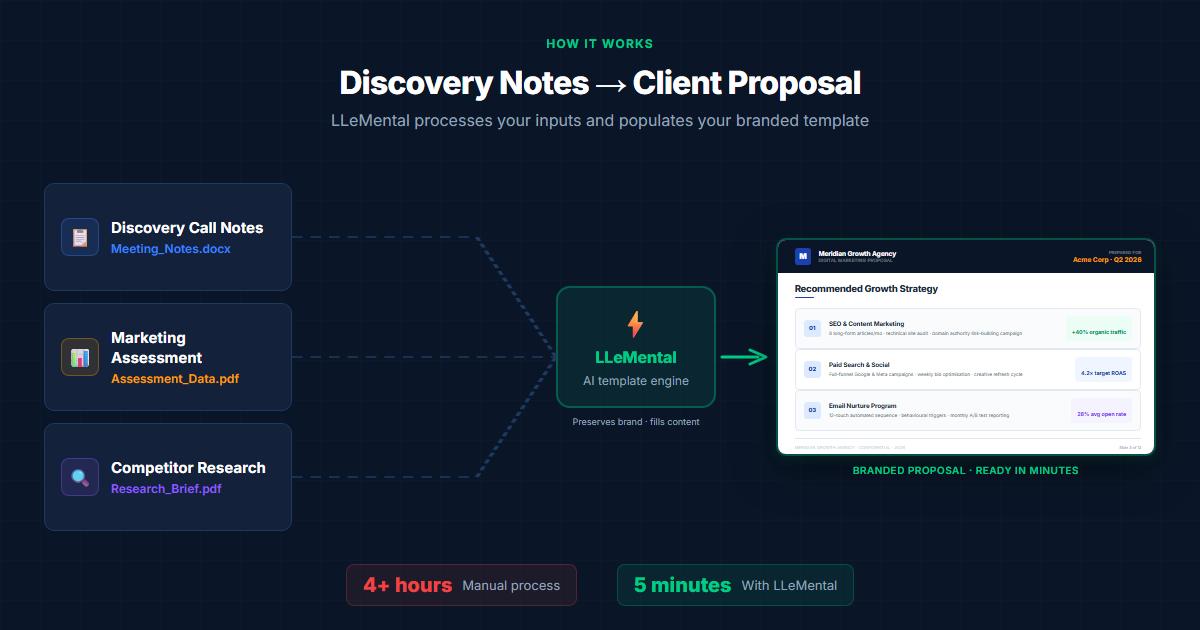
Proposal Automation: Discovery Calls to Client Proposals
A simple workflow could look like this:
1. Client intake formCollect initial requirements and project details
2. Discovery callConduct structured client interviews
3. Meeting notes and transcriptCapture requirements and decisions with consent
4. AI requirement analysisIdentify gaps, assumptions, risks, and hidden scope
5. Scope document generationCreate requirements, deliverables, and exclusions
6. Proposal and estimationReview, validate, and send to the client
Recommended tools
| Workflow requirement | Suggested tools |
|---|---|
| Client intake forms | Google Forms, Tally |
| Scheduling | Calendly, Google Calendar |
| Video meetings | Google Meet, Zoom |
| AI meeting summaries | ChatGPT, Gemini |
| Workflow automation | n8n, Make |
| Requirements management | Notion, Google Docs |
| Project estimation | Google Sheets |
| Proposals | Google Docs, Canva |
For freelancers who prefer self-hosted automation, n8n is particularly useful for connecting intake forms, AI processing, document generation, and client notifications.
8. Common discovery-call mistakes to avoid
Even experienced freelancers can miss important requirements during client conversations.
Here are some common mistakes:
1. Accepting vague requirements
A client saying “I need an application similar to Uber” does not provide enough information for an accurate estimate.
2. Discussing price too early
Without understanding functionality, dependencies, and deliverables, any initial estimate is likely to be inaccurate.
3. Ignoring non-functional requirements
Security, performance, availability, scalability, and maintainability can substantially influence project complexity.
4. Not documenting exclusions
If something is not explicitly excluded, clients may assume it is included.
5. Failing to identify decision-makers
A project can be delayed when the person attending the discovery call does not have approval authority.
6. Treating AI-generated requirements as confirmed facts
AI can organize information and identify gaps, but the client must validate the actual requirements.
7. Forgetting change-request management
Agree on how additional requirements, revisions, and changes will be estimated and approved.
9. Your discovery-call checklist
Use this checklist before finalizing any project proposal.
Discovery readiness
0/13 completedBusiness objectives and pain points documentedTarget users and stakeholders identifiedFunctional requirements clarifiedTechnical requirements and integrations identifiedDeliverables and quantities confirmedScope exclusions documentedBudget expectations discussedTimeline and milestones discussedClient dependencies identifiedRisks and assumptions documentedAcceptance criteria agreedDecision-maker and approval process confirmedNext steps communicated
Reset checklist
10. Final thoughts: Turn better conversations into profitable projects
A successful freelance engagement starts long before the actual work begins.
The quality of your discovery process determines how accurately you understand client expectations, estimate project effort, manage delivery risks, and protect your profitability.
AI makes this process significantly more efficient. You can prepare tailored questions, analyze meeting notes, identify missing requirements, uncover hidden scope, and generate structured project documents in a fraction of the time.
However, remember that AI is an assistant, not a replacement for professional judgment. The freelancer remains responsible for validating requirements, clarifying assumptions, and securing client approval.
Start with a structured discovery questionnaire, build your reusable prompt library, and gradually automate the entire workflow.
Your goal should be simple: Every discovery call should end with clarity about the problem, the deliverables, the responsibilities, the budget, and the next steps.
SEO publishing details
WordPress SEO configuration
SEO title
Prompt Library for Discovery Calls: Questions to Uncover Project Scope
Suggested URL slug
prompt-library-discovery-calls-questions-uncover-scope
Meta description Copy
Use this AI prompt library for freelance discovery calls. Ask smarter client questions, uncover hidden requirements, define project scope, and prepare better proposals.
Focus keyword
discovery call questions for freelancers
Secondary keywords
- AI prompts for freelancers
- Client discovery questionnaire
- Project scope discovery
- Freelance client onboarding
- Project requirement gathering
- AI project management prompts
Suggested WordPress categories
Freelancing, AI Tools, Productivity
Suggested tags
Discovery Calls, ChatGPT Prompts, Freelance Business, Client Management, Project Scoping, AI Automation