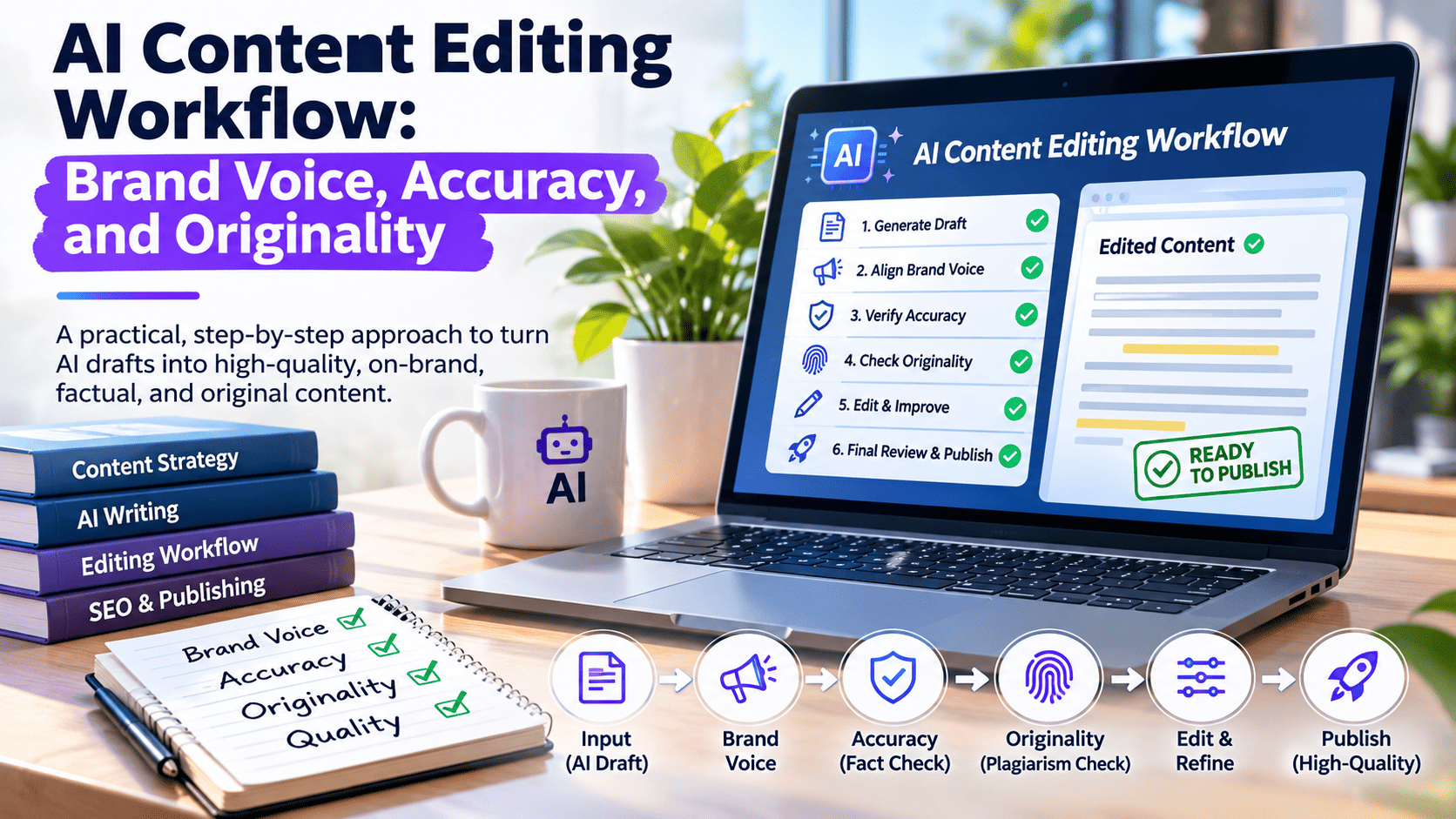
AI Content Editing Workflow: Brand Voice, Accuracy, and Originality

AI Content Editing Workflow: Brand Voice, Accuracy, and Originality
SEO-optimised WordPress article
AI & Content Marketing
Creating content with AI has become easier than ever. From blog posts and landing pages to social media campaigns and product descriptions, AI writing tools can generate large volumes of content in minutes.
However, generating content is only the first step. The real challenge is ensuring that AI-generated content sounds like your brand, communicates accurate information, provides genuine value, and maintains originality.
A well-defined AI content editing workflow helps businesses, bloggers, freelancers, and digital marketers transform machine-generated drafts into high-quality content that readers trust and search engines can understand.
This guide explains a practical, step-by-step AI content editing process covering brand voice, fact-checking, originality, SEO optimisation, and final publishing.
1. Why AI-generated content needs human editing
AI writing tools are excellent at generating ideas, structuring articles, summarising information, and improving productivity. However, AI-generated drafts can still contain several problems:
- Generic language that sounds similar across websites.
- Repetitive sentences and unnecessary explanations.
- Incorrect statistics, references, or technical claims.
- Outdated information presented as current.
- Unsupported statements and fabricated citations.
- Content that does not reflect the company’s brand personality.
- Similar phrasing that reduces originality and differentiation.
- SEO keywords inserted unnaturally.
Publishing an AI-generated article without reviewing these issues can negatively affect audience trust and content quality.
The objective should not be to eliminate AI from content creation. Instead, businesses should combine AI efficiency with human judgement, subject expertise, and editorial standards.
2. Understand your brand voice before editing
Brand voice is the personality and communication style that makes your content recognisable.
For example, a cybersecurity company may use a professional, authoritative, and technically precise tone, whereas a lifestyle blog may prefer a friendly, conversational, and engaging writing style.
Before editing an AI-generated article, establish a brand voice guideline.
Essential brand voice elements
| Element | What to define |
|---|---|
| Tone | Professional, friendly, conversational or authoritative |
| Language | Simple, technical, educational or persuasive |
| Audience | Beginners, professionals, businesses or consumers |
| Sentence style | Short, direct or explanatory |
| Vocabulary | Preferred terminology and industry language |
| Personality | Helpful, innovative, trustworthy or analytical |
| Formatting | Headings, lists, examples and tables |
Example: Brand voice transformation
AI-generated sentence:
“Artificial intelligence is a powerful technology that helps businesses improve their operations and achieve better results.”
Improved brand-oriented version:
“AI helps businesses automate repetitive tasks, uncover operational insights, and make faster, data-driven decisions.”
The second version is more specific, informative, and useful to a professional audience.
Create a reusable brand voice prompt
You can use the following prompt when editing content with AI:
AI brand voice editing prompt
Reusable prompt
Act as a senior content editor and brand communication specialist.
Review the supplied article and rewrite it according to the following brand guidelines:
- Maintain a professional yet conversational tone.
- Use clear, natural, human-readable language.
- Avoid generic AI-style expressions and repetitive phrases.
- Prioritise practical insights, examples, and actionable recommendations.
- Maintain consistency in terminology and writing style.
- Preserve the original meaning and factual claims.
- Do not introduce unsupported information.
Ensure the final article sounds consistent with an established technology and digital innovation publication.
Content to edit: [Paste your draft here] Copy prompt
3. Establish an accuracy and fact-checking process
One of the most important stages of AI content editing is verifying factual accuracy.
AI models can produce convincing explanations while making mistakes in technical specifications, statistics, regulations, product features, and industry developments.
This is particularly important for content involving finance, cybersecurity, healthcare, technology, legal compliance, and business regulations.
A practical fact-checking checklist
- Verify statistics: Check numerical claims against original reports and recognised sources.
- Validate technical information: Compare specifications, product features, and technical explanations with official documentation.
- Check dates: Ensure that references to current developments are relevant and up to date.
- Validate external references: Open every cited source and confirm that it supports the associated statement.
- Review legal and regulatory claims: Refer to official government and regulatory publications.
- Remove unsupported statements: Rewrite or remove claims that cannot be independently verified.
Recommended fact-checking resources
| Resource | Recommended use |
|---|---|
| Google Search | Discover original sources and supporting evidence |
| Google Scholar | Research academic studies |
| Perplexity | Research with source-linked answers |
| Microsoft Learn | Verify Microsoft technology documentation |
| AWS Documentation | Validate AWS technical information |
| FactCheck.org | Review selected public-interest claims |
Editorial rule: Never treat an AI-generated reference, statistic, quotation, or source as verified until you have checked the original material.
4. Check content originality and avoid duplication
Originality is not simply about changing words or replacing phrases with synonyms.
High-quality original content should contribute something meaningful that readers cannot easily find in dozens of similar articles.
This can include:
- Personal professional experiences.
- Original research and observations.
- Practical implementation examples.
- Industry-specific insights.
- Unique comparisons and evaluations.
- Original frameworks and checklists.
- Lessons learned from real projects.
How to improve originality in AI-generated content
Step 1: Identify generic sections
Look for paragraphs that provide broad explanations without meaningful insights.
Step 2: Add practical examples
Replace generic explanations with realistic business scenarios, implementation challenges, or measurable outcomes where evidence is available.
Step 3: Include expert perspectives
Add insights from people who understand the subject rather than relying exclusively on AI-generated explanations.
Step 4: Review competing content
Understand what existing articles cover and identify opportunities to answer additional questions or provide better explanations.
Step 5: Check for accidental duplication
Use plagiarism detection tools to identify overlapping text and investigate the original sources.
Useful originality and writing tools
Grammarly: AI Writing and Grammar App – Download and install on Windows | Microsoft Store
Grammarly
Helps review grammar, clarity, readability, and writing consistency.
Copyscape Price, Features and Reviews in 2026 | Techjockey US
Copyscape
Helps identify potentially duplicated web content.
QuillBot: la herramienta de IA para mejorar la escritura | Universo Abierto
QuillBot
Supports paraphrasing, grammar improvements, and sentence refinement.
Remember that plagiarism detection, AI detection, and originality are different concepts. A low plagiarism score does not automatically mean an article offers original insights. Likewise, AI detectors are not definitive proof of how a piece of content was created.
5. Improve readability and content structure
Even factually correct content may fail to engage readers if it is difficult to read.
AI-generated articles sometimes contain lengthy introductions, repetitive paragraphs, excessive bullet points, and unnecessary technical terminology.
A good editorial workflow should improve readability without compromising depth.
Recommended editing techniques
- Keep paragraphs focused on one primary idea.
- Use descriptive H2 and H3 headings.
- Break complex explanations into smaller sections.
- Include examples wherever they improve understanding.
- Use tables for comparisons and structured information.
- Remove redundant introductory and concluding sentences.
- Explain technical terminology when addressing beginners.
- Use active voice wherever it improves clarity.
Recommended content structure
| Article component | Editorial objective |
|---|---|
| Introduction | Explain the reader’s problem |
| Main sections | Answer the primary questions |
| Examples | Demonstrate practical applications |
| Tables | Simplify complex comparisons |
| Actionable tips | Help readers implement solutions |
| FAQs | Address related search queries |
| Conclusion | Reinforce the main takeaway |
6. Optimise content for Google, AI search, and chatbots
Modern content optimisation should go beyond traditional keyword placement.
People increasingly discover information through conversational search experiences, AI assistants, and answer engines.
Your content should therefore be structured so that both humans and automated systems can understand its subject, context, and supporting information.
Traditional SEO optimisation
Focus on:
- Primary keyword placement in the title and introduction.
- Relevant secondary and long-tail keywords.
- Descriptive heading structure.
- Search-intent alignment.
- Relevant internal and external links.
- Optimised images and descriptive alt text.
- Mobile-friendly formatting.
- Appropriate metadata and canonical URLs.
AI search and chatbot optimisation
For better discoverability in AI-powered search experiences:
- Answer important questions directly.
- Use descriptive headings that clearly identify each topic.
- Include factual explanations supported by credible sources.
- Define technical terms and industry concepts.
- Use structured lists and comparison tables.
- Demonstrate subject expertise through meaningful examples.
- Keep information consistent across related articles.
- Provide clear author information and publication dates.
- Maintain accessible, crawlable website content.
For example, rather than writing:
“AI editing is important for modern content marketing.”
Use a more informative explanation:
“AI content editing is the process of reviewing and improving AI-generated text for factual accuracy, brand consistency, originality, readability, and search visibility before publication.”
The second statement provides a clearer definition that can be understood independently.
Important: There is no guaranteed formula for getting content cited by AI chatbots. Structured, useful, accurate content improves comprehension and accessibility, but inclusion in AI-generated answers depends on each platform’s retrieval and ranking systems.
7. Implement a repeatable AI content editing workflow
The most effective approach is to create a standard operating procedure (SOP) that every content creator and editor can follow.
Here is a practical workflow suitable for independent bloggers, marketing teams, agencies, and technology companies.
How to Build an AI Content Workflow Without Losing Your Voice | TechSifted
The seven-stage editing workflow
- Stage 1: AI draft generationGenerate the initial article using a clearly defined topic, target audience, search intent, content outline, and primary keywords.Output: Initial article draft.
- Stage 2: Brand voice alignmentReview tone, terminology, sentence structure, and messaging against the brand guidelines.Output: Brand-consistent draft.
- Stage 3: Fact verificationValidate technical explanations, statistics, references, dates, and factual claims against authoritative sources.Output: Fact-checked content.
- Stage 4: Originality reviewIdentify generic explanations, repetitive content, accidental duplication, and opportunities to add original insights.Output: Differentiated content.
- Stage 5: Editorial refinementImprove readability, grammar, structure, transitions, examples, and overall communication quality.Output: Publication-ready editorial draft.
- Stage 6: SEO and AI search optimisationReview metadata, headings, keywords, internal links, FAQs, image attributes, and structured data where appropriate.Output: Search-optimised article.
- Stage 7: Human approval and publishingComplete the final editorial review, approve the article, publish it, and monitor performance.Output: Published and quality-approved content.
8. Build an AI-powered content editing toolkit
You do not need an expensive enterprise platform to implement an effective editing workflow.
A combination of AI writing assistants, research tools, SEO plugins, and human editorial reviews can provide a practical solution.
| Workflow requirement | Suggested tool |
|---|---|
| AI draft generation | ChatGPT |
| Alternative AI research | Perplexity |
| Grammar and readability | Grammarly |
| Plagiarism review | Copyscape |
| SEO optimisation | Rank Math |
| Image creation | OpenAI Image Generation |
| Content publishing | WordPress |
| Workflow automation | n8n |
For WordPress publishers, an automated workflow can be designed to:
- Receive an approved article draft.
- Run brand voice and editorial checks.
- Flag claims requiring source verification.
- Generate SEO metadata suggestions.
- Prepare featured images and image attributes.
- Create a WordPress draft.
- Notify the editor for final approval.
Human approval should remain an essential step before publishing.
9. Measure the quality of your AI-edited content
A successful content editing workflow should produce measurable improvements rather than simply increasing article output.
Consider introducing an editorial quality scorecard.
| Quality dimension | Suggested weight |
|---|---|
| Brand voice consistency | 20% |
| Factual accuracy | 25% |
| Originality and unique value | 20% |
| Readability and structure | 15% |
| SEO and search intent | 15% |
| Grammar and formatting | 5% |
| Total | 100% |
Use a minimum internal approval threshold of 85/100 as a starting editorial target, with factual accuracy treated as a mandatory approval requirement regardless of the overall score.
Monitor these additional performance indicators:
- Organic search impressions and clicks.
- Search rankings for target keywords.
- Reader engagement and scroll depth.
- Conversion rates and enquiries.
- Referral traffic from relevant platforms.
- Content updates and correction frequency.
A high-quality article is not necessarily the longest article. It is the one that answers the reader’s question accurately, clearly, and usefully.
10. Common mistakes to avoid when editing AI content
Avoid these practices when developing an AI-assisted publishing process:
1. Publishing without fact-checking: AI-generated information should never automatically be treated as verified.
2. Over-editing every sentence: Excessive rewriting can remove useful information and make the article less natural.
3. Keyword stuffing: Repeating the same keyword unnaturally damages readability.
4. Ignoring brand guidelines: Content should maintain a consistent identity across all publishing channels.
5. Relying entirely on plagiarism scores: Originality requires meaningful insights, not just a low similarity percentage.
6. Removing human expertise: AI should support subject-matter experts, not replace their judgement.
7. Publishing at the expense of quality: More articles do not automatically mean better search visibility or audience engagement.
11. The future of AI-assisted content editing
AI content editing is moving towards more intelligent and automated editorial systems.
Emerging approaches include:
- Brand-aware AI editing assistants.
- Automated source verification and citation checks.
- Knowledge-base-driven content generation.
- AI-powered editorial quality scoring.
- Multilingual content localisation.
- Automated content freshness monitoring.
- Personalised content optimisation.
- Human-in-the-loop editorial approval.
For businesses publishing content at scale, these capabilities can help create a repeatable content governance framework.
The future is not about allowing AI to publish everything automatically. It is about using AI to make content creation faster while maintaining accuracy, originality, and editorial accountability.
Conclusion: Make AI-generated content genuinely valuable
AI has transformed the way businesses create digital content, but publishing high-quality articles still requires thoughtful editing and human oversight.
A structured AI content editing workflow ensures that every article reflects your brand identity, contains reliable information, delivers original value, and addresses the reader’s search intent.
Whether you are an independent blogger, freelance consultant, digital marketing agency, or enterprise content team, start with three essential principles:
- Brand voice: Make every article sound consistent with your organisation.
- Accuracy: Verify information before publishing.
- Originality: Add meaningful insights that distinguish your content.
When these principles are combined with SEO best practices and human editorial judgement, AI becomes a powerful content productivity tool rather than just an article-generation machine.
Frequently asked questions (FAQs)
1. What is an AI content editing workflow?
An AI content editing workflow is a structured process for reviewing and improving AI-generated content. It includes brand voice alignment, fact-checking, originality verification, readability improvements, SEO optimisation, and final human approval.
2. How do I maintain brand voice when using AI?
Create a documented brand voice guide covering tone, vocabulary, audience, writing style, and messaging preferences. Use it as a consistent reference when generating and editing AI content.
3. How can I check the accuracy of AI-generated articles?
Verify factual claims using authoritative sources, official documentation, original research, and credible publications. Review statistics, technical specifications, dates, and references before publication.
4. Does AI-generated content affect Google rankings?
Using AI to create content does not automatically make it ineligible for Google Search. Google’s guidance focuses on content quality, usefulness, reliability, and whether content is created primarily to manipulate search rankings.
5. Which tools are best for AI content editing?
ChatGPT, Grammarly, Perplexity, Copyscape, and Rank Math can support different stages of the editing process. The appropriate combination depends on your content requirements and publishing workflow.
6. How can I make AI content more original?
Add original research, professional experience, real-world examples, unique comparisons, expert commentary, and independently developed insights. Avoid relying on simple paraphrasing.
7. Should AI-generated content be reviewed by a human before publishing?
Yes. Human review is particularly important for factual accuracy, legal and regulatory claims, technical information, brand consistency, and editorial accountability.