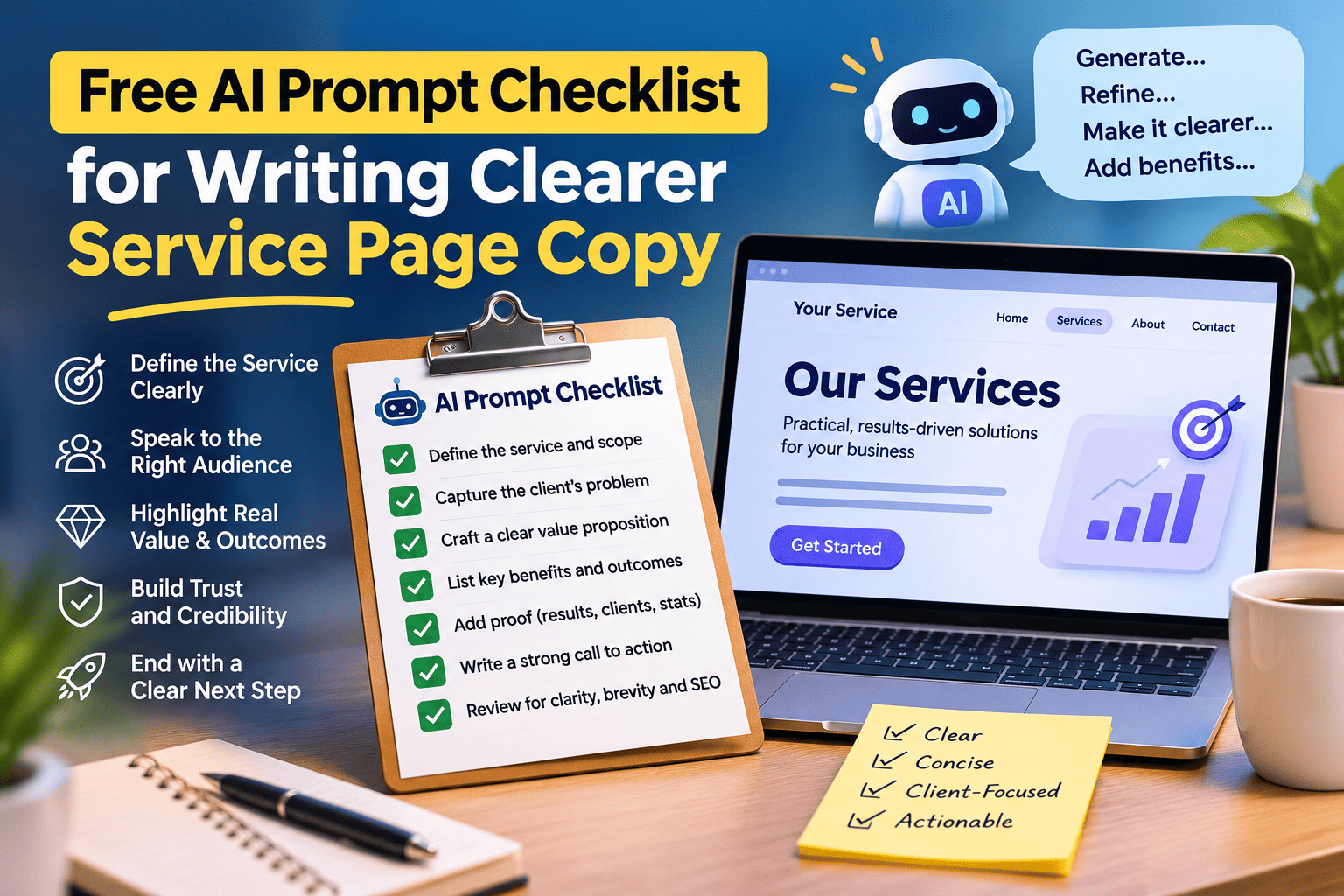
Free AI Prompt Checklist for Writing Clearer Service Page Copy

Your service page is often the first place potential clients visit before deciding whether to contact you. It needs to explain what you offer, who you help, what problems you solve, and why someone should choose you.
Yet many freelancers and small businesses struggle to communicate their services clearly. Their websites contain generic statements such as “We deliver innovative solutions” or “We provide high-quality professional services.” These statements sound impressive but rarely tell visitors what they will actually receive.
Artificial intelligence can help solve this problem. With the right prompts, tools such as ChatGPT, Gemini, and Claude can help you write clearer headlines, explain service benefits, organize website content, and create stronger calls to action.
The secret is not simply asking AI to write a service page. It is giving AI the right instructions, context, and review criteria.
In this guide, you will find a free AI prompt checklist, ready-to-use prompts, and a practical workflow to create clearer service page copy.
1. Why Clear Service Page Copy Matters
A service page should answer five important questions:
- What exactly do you offer?
- Who is your service designed for?
- What problem does it solve?
- What makes your approach valuable?
- What should visitors do next?
If visitors cannot understand these answers quickly, they may leave without contacting you.
Clear service page copy helps you:
- Communicate your value proposition.
- Attract more relevant potential clients.
- Set realistic expectations about deliverables.
- Build trust through specific information.
- Reduce unnecessary questions from prospects.
- Encourage visitors to request a consultation or quotation.
Your objective should not be to use complicated marketing language. It should be to make your service easy to understand and evaluate.
2. Prepare Your Information Before Using AI
AI-generated content is only as useful as the information you provide.
Before generating copy, collect the following details:
| Information | What to provide |
|---|---|
| Business name | Your company or personal brand |
| Service name | The specific service you offer |
| Target audience | Ideal customers or industries |
| Customer problem | The challenge your service addresses |
| Service scope | Activities included in the service |
| Deliverables | What the customer receives |
| Differentiator | What makes your approach distinctive |
| Evidence | Testimonials, experience or case studies |
| Call to action | What visitors should do next |
For example, instead of telling AI to write about “IT consulting”, provide more useful context:
“We provide cloud architecture consulting to growing businesses that need to modernize legacy applications, improve infrastructure scalability, and manage cloud costs.”
This gives AI a much stronger foundation.
3. The Free AI Prompt Checklist
Use this checklist before publishing any service page.
A. Service clarity checklist
- Does the headline clearly describe the service?
- Can a first-time visitor understand the offering?
- Is the target audience clearly identified?
- Does the introduction explain the customer’s problem?
- Are technical terms explained in simple language?
B. Value proposition checklist
- Does the page explain why the service matters?
- Are customer benefits clearly described?
- Are outcomes connected to actual service capabilities?
- Is the business’s differentiation explained?
- Are unsupported promises avoided?
C. Service scope checklist
- Are the included activities listed?
- Are deliverables explained?
- Are timelines mentioned only when they can be supported?
- Are limitations or exclusions clarified where necessary?
- Can customers understand what happens after contacting you?
D. Trust and credibility checklist
- Are relevant qualifications or experience included?
- Are testimonials genuine and authorized?
- Are case studies supported by real project information?
- Are statistics accurate and verifiable?
- Does the page avoid exaggerated claims?
E. Conversion checklist
- Is there a clear primary call to action?
- Is the next step easy to understand?
- Is contact information accessible?
- Are common customer questions answered?
- Does the page avoid unnecessary distractions?
F. SEO checklist
- Is there one primary search keyword?
- Does the title include the main keyword naturally?
- Is the search intent addressed?
- Are relevant secondary keywords included naturally?
- Is the meta description compelling?
- Are headings logically structured?
- Are image alt texts descriptive?
- Are internal links relevant?
4. Seven Free AI Prompts for Better Service Page Copy
The following prompts can be used with ChatGPT, Gemini, Claude, or other AI writing assistants. Replace the information in square brackets with your actual business details.
Prompt 1: Define Your Service Clearly
Use this prompt to explain your service in straightforward language.
Copy-and-paste prompt:
“Act as an experienced website copywriter. Help me explain my service in clear, simple, customer-focused language.
Business: [Business Name]
Service: [Service Name]
Target audience: [Target Audience]
Customer problem: [Problem]
Service scope: [What You Provide]
Write:
- A one-sentence service description.
- A short introduction of approximately 80 words.
- Five key service features.
- Five customer benefits.
Avoid generic marketing phrases, unnecessary jargon, and unsupported claims. Focus on clarity and practical value.”
Prompt 2: Create a Strong Service Page Headline
Your headline should immediately communicate what you offer and who benefits from it.
Copy-and-paste prompt:
“Act as a conversion-focused website copywriter.
My service is [Service Name], designed for [Target Audience].
The main customer challenge is [Customer Problem].
Generate 10 service page headlines that:
- Clearly describe the service.
- Communicate a meaningful benefit.
- Avoid exaggerated promises.
- Use natural, conversational language.
- Make sense to someone unfamiliar with the industry.
For each headline, explain why it works and recommend the strongest option.”
Prompt 3: Convert Features into Customer Benefits
Many service providers describe what they do without explaining why customers should care.
Copy-and-paste prompt:
“Act as a professional marketing strategist.
Convert the following service features into customer-focused benefits.
Service features:
[Insert Features]
Target audience:
[Insert Audience]
For each feature, provide:
- The original feature.
- The practical customer benefit.
- The problem it helps address.
- A short website-ready description.
Do not invent measurable results or guarantee outcomes. Make the language specific and understandable.”
Prompt 4: Build a Complete Service Page Structure
Use this prompt to create the initial content structure.
Copy-and-paste prompt:
“Act as a senior UX content strategist and SEO copywriter.
Create a complete website service page structure for:
Business: [Business Name]
Service: [Service Name]
Target audience: [Audience]
Primary customer problem: [Problem]
Main service benefits: [Benefits]
Include these sections:
- Main headline and introduction.
- Customer challenges.
- Our service and approach.
- Key features and benefits.
- Service process.
- Deliverables.
- Why choose us.
- Frequently asked questions.
- Final call to action.
For each section, suggest a heading and explain its purpose. Maintain a logical flow and avoid repeating information.”
Prompt 5: Simplify Technical Service Descriptions
This is particularly useful for IT consultants, software development agencies, cloud architects, and technology service providers.
Copy-and-paste prompt:
“Act as a technical content specialist who writes for non-technical business decision-makers.
Rewrite the following service description in simple business language:
[Insert Technical Description]
Requirements:
- Retain technical accuracy.
- Explain unfamiliar terms.
- Highlight the business problem being addressed.
- Explain practical benefits.
- Avoid unnecessary technical jargon.
- Keep the writing professional and conversational.
Provide both a short version and a detailed website version.”
Prompt 6: Improve Your Call to Action
A good call to action tells visitors exactly what to do next.
Copy-and-paste prompt:
“Act as a conversion copywriter.
My service: [Service Name]
My target audience: [Audience]
The next action I want visitors to take: [Book a Consultation / Request a Quote / Contact Us]
Generate 10 professional call-to-action options.
Make them clear, relevant, and action-oriented. Avoid aggressive sales language and unrealistic promises.
Also recommend the best primary CTA and two alternative CTAs.”
Prompt 7: Review and Improve the Entire Service Page
Use this final prompt before publishing.
Copy-and-paste prompt:
“Act as an independent website content auditor, UX writer, and SEO specialist.
Review the following service page:
[Paste Complete Service Page]
Evaluate it against these criteria:
- Service clarity.
- Audience relevance.
- Value proposition.
- Feature-to-benefit communication.
- Content structure.
- Trust and credibility.
- Readability.
- SEO optimization.
- Call-to-action effectiveness.
- Accuracy and unsupported claims.
Provide:
- A score out of 10 for each criterion.
- The five most important weaknesses.
- Specific recommendations.
- A revised version of the weakest sections.
Do not invent testimonials, certifications, statistics, customer results, or business credentials.”
5. A Practical 30-Minute AI Service Page Workflow
You do not need an expensive AI subscription or a professional copywriting agency to create your first service page draft.
You can use a simple workflow with free AI tools.
| Time | Activity | Expected output |
|---|---|---|
| 0–5 min | Collect business and service details | Service brief |
| 5–10 min | Generate headlines and introduction | Opening copy |
| 10–15 min | Generate features and benefits | Service descriptions |
| 15–20 min | Create page structure | Complete draft |
| 20–25 min | Review clarity and SEO | Improved copy |
| 25–30 min | Verify facts and publish preparation | Final draft |
Suggested free tools:
- ChatGPT: Content drafting, rewriting, and prompt-based reviews.
- Google Gemini: Brainstorming and alternative content approaches.
- Grammarly: Grammar and readability checks, subject to free-plan limits.
- Google Trends: Exploring search interest and related topics.
- Google Search Console: Reviewing actual search performance after publishing.
Free-plan availability and features may change. Check each provider’s current terms before relying on a particular feature.
6. Example: Before and After AI Copy Improvement
Consider a small IT consulting business offering cloud migration services.
Before: Generic service copy
“We provide innovative cloud solutions to help businesses achieve digital transformation through scalable and reliable technology services.”
The statement sounds professional, but it does not explain the service, its scope, or its practical value.
After: Clearer service copy
“We help growing businesses move their applications and infrastructure to the cloud. Our cloud migration consulting covers architecture assessment, migration planning, workload modernization, and post-migration optimization. The goal is to create a more manageable, scalable cloud environment aligned with your business and technical requirements.”
The improved version explains:
- Who the service helps.
- What the service covers.
- Which activities are included.
- What the intended business outcome is.
Notice that the revised copy does not promise guaranteed cost savings or performance improvements. It communicates value without making unsupported claims.
7. Common AI Copywriting Mistakes to Avoid
AI can accelerate content creation, but blindly publishing generated text can damage your credibility.
Watch out for these mistakes:
1. Using generic AI language
Phrases such as “unlock your potential” and “revolutionize your business” are often too vague. Replace them with specific explanations of what you actually deliver.
2. Targeting everyone
A service page designed for every possible customer often fails to connect with anyone. Define your primary audience.
3. Inventing business credentials
Never allow AI to fabricate certifications, customer testimonials, case studies, awards, or project experience.
4. Overloading the page with keywords
SEO keywords should support readability, not interrupt it. Use relevant phrases naturally.
5. Describing features without outcomes
Customers are interested in how your service helps them. Connect each important feature to a practical customer benefit.
6. Ignoring mobile readability
Long paragraphs and complicated headings make pages harder to read on mobile devices. Use concise paragraphs, descriptive headings, and scannable lists.
7. Publishing without human review
Check every factual statement, service detail, pricing reference, and promise before publication.
8. Final Free AI Service Page Publishing Checklist
Before publishing, use this final checklist:
- The page clearly describes one primary service.
- The headline communicates the main offering.
- The introduction addresses the intended audience.
- Customer problems are explained.
- Service features and benefits are separated.
- Deliverables and scope are accurate.
- Credibility claims are verified.
- The content is easy to read.
- The primary keyword appears naturally.
- The SEO title and meta description are prepared.
- Images have descriptive alt text.
- Internal links point to relevant pages.
- The CTA is visible and functional.
- The page works correctly on mobile.
- All content has been reviewed by a human.
Conclusion: Use AI to Make Your Service Easier to Understand
A successful service page does not need complicated language or excessive marketing claims. It needs to communicate the right information to the right audience.
AI tools can help freelancers, consultants, and small business owners move from vague service descriptions to clear, structured, customer-focused website content.
Start with the free prompt checklist in this article. Define your audience, explain the problems you solve, describe your deliverables, and ask AI to improve the clarity of your message.
Most importantly, treat AI as a writing assistant rather than a replacement for your business knowledge. Your experience, actual capabilities, and understanding of customer needs should remain at the centre of every service page.
Your next step: Choose one service on your website, run it through the seven prompts, and review the result against the publishing checklist. A clearer service page is a practical starting point for building customer trust and generating better enquiries.